

By Adaobi Rhema Oguejiofor
Nigeria’s housing crisis has long existed as both an economic challenge and a social reality. Across major cities and emerging urban centres, millions of Nigerians continue to struggle with rising rent costs, limited access to affordable mortgages, inadequate infrastructure, and a persistent shortage of decent housing.
Amid the growing urbanisation and population expansion, the Federal Government appears very determined to move beyond policy conversations toward large-scale execution. At the centre of this renewed push is a strategic roadmap unveiled by the Federal Government through the Federal Ministry of Housing and Urban Development, aimed at transforming housing delivery, strengthening the built environment, and deepening collaboration with the private sector.
Speaking during the Renewed Hope Housing Public-Private Partnership Summit in Abuja, the Minister of Housing and Urban Development, Muttaqha Rabe Darma, described the initiative as a major step toward redefining how housing projects are financed, developed, and delivered across the country.
The summit reflected a growing consensus within government circles that solving Nigeria’s housing deficit can no longer depend solely on direct government funding. Instead, officials are increasingly embracing public-private partnerships (PPPs) as a critical pathway for scaling delivery, mobilising capital, and accelerating urban development.
For years, Nigeria’s housing sector has struggled under the weight of enormous demand. With rapid population growth, urban migration, and rising construction costs, the country’s housing deficit has continued to widen, placing affordable homeownership beyond the reach of many citizens. Against this backdrop, the government’s latest roadmap signals an attempt to reposition housing not merely as a social necessity but as a strategic economic driver capable of stimulating employment, industrial growth, and infrastructure expansion.
Darma explained that the ministry is deliberately shifting “from policy to projects”, focusing on practical implementation through strategic partnerships involving government institutions, private developers, financiers, and critical stakeholders within the built environment.
According to the minister, consultations with agencies and departments under the ministry are nearing completion, with the official unveiling of the ministry’s broader strategic plan expected before the end of May. The framework, he said, would provide a coordinated direction for housing delivery nationwide while strengthening accountability and execution.

More importantly, the roadmap appears designed to create continuity between policy ambition and visible outcomes.
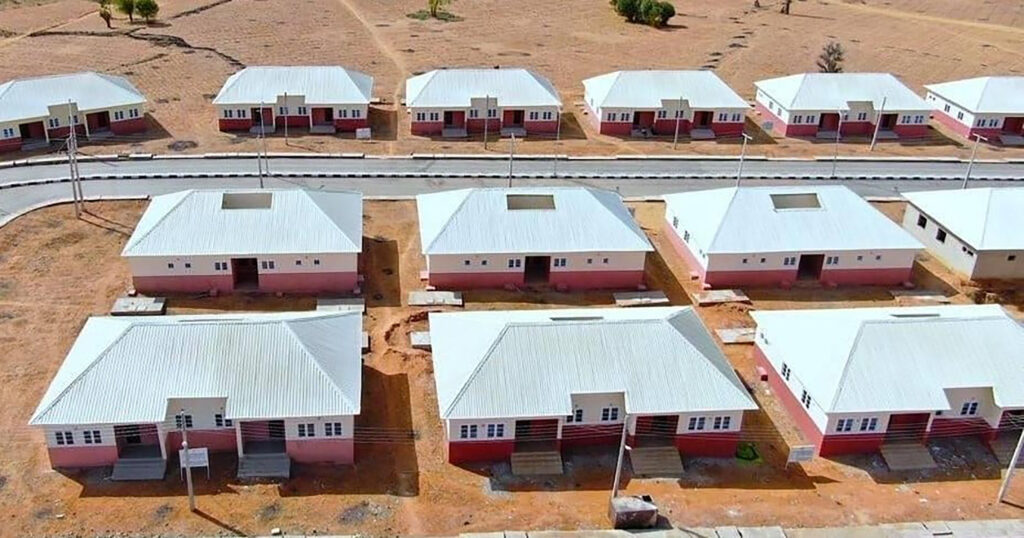
Already, major housing developments are ongoing in Ibeju-Lekki in Lagos State, Lambu in Kano State, and Karsana in Abuja. Upon completion, the projects are expected to be commissioned by President Bola Ahmed Tinubu as part of the administration’s Renewed Hope Housing Agenda.
But beyond the symbolism of large-scale housing estates lies a more ambitious economic vision. The government says it intends to build a sustainable housing framework anchored on innovative financing systems, inclusive participation, and stronger PPP models. Analysts believe this approach could help bridge the longstanding funding gap that has historically slowed housing delivery in Nigeria.
One of the biggest obstacles confronting developers remains access to long-term, affordable finance. Construction projects require significant capital investment, while mortgage accessibility for average Nigerians remains limited due to high interest rates and weak financing structures. By drawing private-sector participation into the process, policymakers hope to unlock new investment channels capable of supporting mass housing development.
The Permanent Secretary of the Ministry, Shaibu Belgore, noted that the summit was convened to deepen collaboration, mobilise financing, and address practical implementation challenges surrounding large-scale housing delivery. According to him, the conversations focused heavily on structuring bankable projects, securing land access, improving institutional coordination, and developing partnerships capable of delivering housing units sustainably and at scale.
His remarks touched on one of the most pressing realities within Nigeria’s housing ecosystem: the real challenge is often not policy formulation but execution. Land administration bottlenecks, infrastructure deficits, high building material costs, weak financing systems, and inconsistent regulatory frameworks have historically slowed housing projects nationwide. Experts argue that unless these structural issues are addressed simultaneously, even the most ambitious housing policies could struggle to achieve meaningful impact.
The ministry disclosed that about 1,550 housing units are currently being developed for military personnel as part of efforts to improve the welfare of members of the armed forces. Authorities also noted that ongoing housing projects have generated employment opportunities for thousands of artisans, engineers, suppliers, contractors, and construction professionals.
In many economies, the construction sector serves as a major engine for economic stimulation and workforce expansion. For Nigeria, where unemployment and underemployment remain significant concerns, the housing sector could emerge as a critical source of economic activity if sustained investment and execution continue.
Industry stakeholders also believe that stronger PPP-driven models could encourage innovation within the sector. From alternative building technologies to more efficient financing structures and smart urban planning systems, collaboration with private developers may help accelerate the modernisation of Nigeria’s built environment.
Another notable highlight of the summit was the launch of the Renewed Hope Housing Magazine, introduced as a strategic communication platform to showcase projects, document progress, highlight investment opportunities, and strengthen stakeholder engagement within the industry.
Beyond communication, however, the success of the government’s housing roadmap will ultimately depend on delivery. For millions of Nigerians searching for affordable, accessible, and decent homes, the true measure of success will not lie in policy documents or summit declarations but in visible projects, functioning communities, accessible mortgages, and sustainable urban development.
Still, the latest signals from the ministry suggest that housing is increasingly being viewed not just as a welfare issue but as a national development strategy capable of reshaping economic growth, infrastructure expansion, and social stability. If effectively implemented, Nigeria’s new housing roadmap could mark the beginning of a more coordinated and execution-driven era for the country’s built environment, one where policy finally translates into projects that ordinary Nigerians can see, access, and call home.
