With $13.4 billion worth of projects unveiled and a new continental bank in the works, AEW 2025 proves Africa’s energy story is no longer about scarcity but sovereignty
By Mohammad Bello
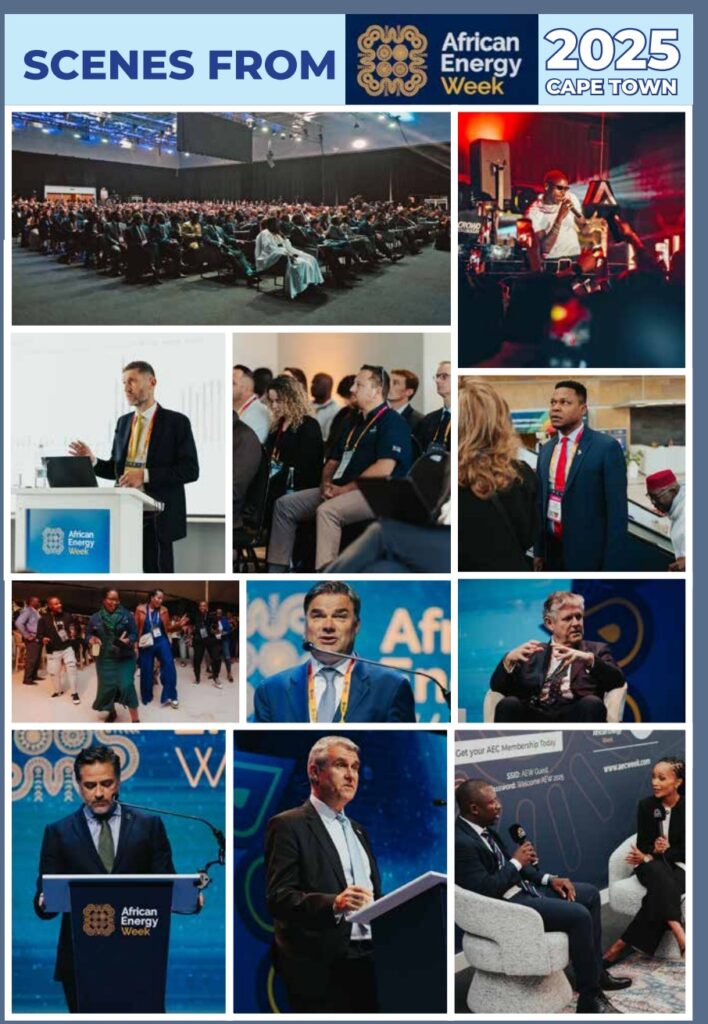
The spring air in Cape Town was crisp, but the atmosphere inside the International Convention Centre was thick with expectation. Delegates in finely tailored suits and traditional attire mingled over coffee, while banners with bold slogans proclaimed “Energy for Africa, Energy by Africa.”
It was the fifth edition of African Energy Week (AEW), a gathering that, since its launch in 2021, has grown into the continent’s most influential energy marketplace. Ministers, oil executives, financiers, and activists came from across Africa, Europe, the United States, the Middle East, and Asia. But unlike other global summits, AEW was striking for a simple reason: here, the conversation was driven not by outsiders, but by Africans.
As the lights dimmed for the opening fireside chat, the theme quickly became clear. This was no ordinary policy discussion; it was an unapologetic declaration that Africa’s energy future would be charted on its own terms.
From Vision to Platform: The Evolution of AEW
When the African Energy Chamber launched AEW in 2021, its goal was deceptively ambitious: to end energy poverty in Africa by 2030. At the time, over 600 million people on the continent lacked access to electricity, while more than 900 million relied on biomass for cooking, with devastating health and environmental consequences.
In its early years, AEW was dismissed by some as another industry talk shop. But the event steadily grew, attracting billions in announced deals, top-tier speakers, and — crucially — a distinctive identity. It was neither a copy of Houston’s CERAWeek nor of Davos’ World Economic Forum. AEW was built as an African platform, deliberately “messy” in its combination of oil barons, climate activists, local entrepreneurs, and geopolitical heavyweights.
By 2025, the Chamber had delivered on its promise of turning the summit into both a policy forum and a deal-making marketplace. “We don’t want AEW to be about talk. We want it to be about transactions,” said NJ Ayuk, the Chamber’s Executive Chairman. “Because transactions create jobs. Jobs put food on tables.”
Gas First, Green Later
The opening fireside chat on Day One captured the spirit of pragmatism. Ministers from Senegal and Ghana joined Kosmos Energy’s CEO, Andrew Inglis, to discuss West Africa’s gas prospects. The conversation revolved around a single principle: use hydrocarbons to power Africa’s development, while gradually building renewables.
Senegal’s Minister reminded the audience that the Greater Tortue Ahmeyim (GTA) LNG project, straddling the border with Mauritania, was not only about exports. Domestic gas utilisation through the Yakaar–Teranga field was central to Senegal’s industrial policy. “We will export to earn revenues, yes, but we must also light our homes, power our factories, and create jobs,” he said.
Ghana’s representative pointed to the country’s gas-to-power program, which had already transformed unreliable electricity supply into one of the region’s most stable grids. Kosmos Energy’s Inglis framed it more bluntly: “Africa doesn’t have the luxury to follow ideology. Gas is the bridge fuel, but in Africa it is also the destination fuel, because it changes lives today.”
The data supported their case. Africa holds over 620 trillion cubic feet of proven natural gas reserves, according to OPEC. Yet the continent accounts for less than 6% of global LNG trade. For many delegates, AEW 2025 was about reversing that imbalance.
The Geopolitics of Power
If the technical panels focused on pragmatism, the political sessions revealed deeper stakes. U.S. Senator Ted Cruz joined the audience through video teleconference. Speaking before the packed hall, he declared: “The United States is here as a partner, as a friend, and as an alternative. We respect your choices. We want to do business with Africa.”
Cruz’s remarks were not just diplomacy. They were a thinly veiled message to Beijing, whose state-backed companies have aggressively financed African energy infrastructure. China already accounts for nearly one-third of all energy project financing in Sub-Saharan Africa, often through concessional loans tied to construction contracts.
Europe, too, loomed in the background. The continent’s energy crisis following Russia’s invasion of Ukraine in 2022 pushed EU countries to scramble for African LNG cargoes. But their climate rhetoric often jarred with African leaders. “When Germany and Denmark can’t find investors for their own wind projects, why should we expect them to invest in ours?” Nigeria’s Minister of State for Petroleum, Senator Heineken Lokpobiri, asked pointedly in his speech.
The Middle East brought another dimension. QatarEnergy and Saudi Aramco sent senior executives, eager to extend investment footprints. With sovereign wealth and deep LNG expertise, Gulf countries are positioning themselves as natural allies for Africa’s gas build-out.
What emerged in Cape Town was a chessboard of competing suitors, but also a new confidence from African policymakers. They were no longer pleading for aid; they were negotiating from strength.
Finance on Africa’s Terms
Nowhere was this clearer than in the announcement of the Africa Energy Bank (AEB), a joint initiative of the African Petroleum Producers’ Organisation (APPO) and Afreximbank. With an initial capitalisation target of $5 billion, the bank aims to close Africa’s energy financing gap, estimated at $90 billion annually.
Dr. Omar Farouk Ibrahim, APPO’s Secretary General, was blunt: “For too long, Africa has depended on others to finance its development. The AEB is our answer. We will fund oil, gas, and renewables with African capital. If the world won’t back us, we will back ourselves.”
Afreximbank’s Executive Vice President, Haytham El Maayergi, added: “The cost of capital in Africa is often two to three times higher than in the OECD. That is financial apartheid. With the AEB, we are saying enough.”
The symbolism mattered as much as the substance. For years, Western financiers have retreated from hydrocarbons, citing ESG mandates. Yet in Africa, hydrocarbons remain essential for revenue, jobs, and industrialization. By pooling sovereign contributions and attracting African pension funds, the AEB could shift the continent from borrower to lender, a psychological as well as financial turning point.
Deals That Shape the Future
The Premier Invest Deal Room was perhaps the most tangible showcase of AEW’s transactional ethos. Organisers announced $13.4 billion worth of projects seeking investment.
Upstream oil and gas led the pack, with more than $12.5 billion in opportunities across Namibia, Mozambique, and Côte d’Ivoire. Namibia’s offshore discoveries alone could add 3 billion barrels of recoverable resources.
Midstream infrastructure required over $2 billion, including pipelines, storage, and LNG regasification terminals.
Downstream projects — refineries, petrochemicals, and distribution networks, sought more than $10 billion.
Renewables and green hydrogen were also present, ranging from solar parks in North Africa to early-stage hydrogen pilots in Mauritania and South Africa.
René Awambeng, Global Head of Client Relations at Afreximbank, described the Deal Room as “a catalyst.” David Thomson of the Chamber was more direct: “This is where the future gets priced, financed, and signed.”
By the end of the week, memoranda of understanding and framework agreements totalling several billion dollars had been inked. While not all would materialise, the sheer scale sent a message: AEW had become Africa’s energy stock exchange.
It was in this context that Julius Rone, Group Managing Director of UTM Offshore, revealed the progress of what could be Nigeria’s most ambitious gas development yet.
“I thank the new management of the NNPC under the leadership of Mr. Bayo Ojulari for ensuring that they carry out Mr President’s directive that gas is developed. When the new management of NNPC came on board, they invited UTM Offshore to present our portion and where we are and the outstanding issues to take our project to bankability and we did.
The NNPC boss gave a directive to the EVP, Gas, to ensure that UTM Offshore sign the gas supply agreement with Seplat, and they have been cooperative. We advanced the negotiations, and within the next two weeks, we should be signing the gas supply agreement, and that is a game changer for the gas industry, having our first floating LNG.”
Rone confirmed that UTM Offshore is engaged in a multi-billion-dollar transaction whose size and partners will soon be announced. Positioned as Nigeria’s first Floating LNG (FLNG) project, it aligns with government priorities on energy transition.
“When the UTM project comes on stream, there will be clean cooking for every Nigerian home, which is an initiative to reduce carbon emissions and to move Nigeria into the transition from fossil to cleaner energy, and gas has been designated for that. The government is putting all the support on the UTM project so that we can develop our stranded offshore gas, and this is very important for the country,” he said.
For many in Cape Town, UTM’s announcement symbolised Nigeria’s determination to harness stranded offshore gas while anchoring its energy transition in gas.
Local Content and Human Capital
Beyond billion-dollar deals, a quieter revolution was underway. Nigeria’s Nigerian Content Development and Monitoring Board (NCDMB) unveiled its strategy to support the country’s ambition of doubling GDP to $1 trillion by 2030.
The plan identified 10 critical skills, from welding and fabrication to digital analytics and subsea engineering, as essential for the oil, gas, and renewables sectors. The Board’s Content Development Fund has already deployed $35 million in low-interest loans to local enterprises.
“Skills, finance, and compliance are our three pillars,” said NCDMB’s Executive Secretary. “If you don’t build local capacity, you don’t build sustainability.”
The compliance element was especially significant. For years, local content rules across Africa were often more aspirational than enforced. Nigeria’s data-driven monitoring, including digital dashboards tracking contractor compliance in real time, is being studied by other African regulators.
Panels also highlighted the role of youth and women. With 70% of Africa’s population under 30, the demographic dividend could become an energy workforce boom or a missed opportunity. Female executives from Angola’s Sonangol and Kenya’s KenGen spoke about breaking barriers in engineering and boardrooms alike.
Technology, Innovation and Hydrogen Dreams
AEW 2025 was not only about oil rigs and LNG trains. Technology and innovation occupied a growing share of panels. Start-ups pitched off-grid solar systems, AI-powered exploration tools, and digital payment platforms for LPG distribution.
Clean cooking fuels emerged as a human story. NJ Ayuk’s voice broke with emotion when he declared, “We cannot talk about energy transition while African women are dying every day from smoke inhalation in their kitchens. LPG is not a luxury. It is a human right.”
Hydrogen was another theme. South Africa and Mauritania presented pilot projects, while Namibia touted its ambition to become a green hydrogen exporter to Europe. Yet scepticism remained. “Hydrogen is exciting, but it is a 2040 story, not a 2025 story,” one delegate quipped. For now, the emphasis was on incremental innovation rather than technological leaps.
Politics and Energy Sovereignty
The sharpest political moment came with Senator Heineken Lokpobiri’s address. Speaking with characteristic candour, he said: “Transition shouldn’t be advocated by Africa. Those who polluted the planet for 200 years should lead the transition. Africa’s contribution to emissions is negligible. Our responsibility is to feed our people, power our industries, and lift our citizens from poverty.”
He went further, citing Germany’s failed wind energy auctions: “If advanced economies can’t mobilise capital for renewables, why should we expect them to mobilise it for us? We must mobilise our own.”
His message resonated across the hall: Africa should engage the West as a partner, but never as a dependent. It was a political line drawn in the sand, and one that reflected the mood of AEW 2025 as a whole.
Looking Ahead: Africa at COP30
As the final day wrapped up, the themes converged. Africa would not abandon hydrocarbons, but it would not ignore renewables either. It would not reject Western capital, but it would not wait for it. It would demand a just transition, but on African terms.
In November, world leaders will gather for COP30 in Belém, Brazil. Africa is expected to arrive with a unified voice shaped in Cape Town: one that insists energy poverty is as urgent a crisis as climate change, and that the path to net zero must allow room for natural gas, oil, and African-driven innovation.
The numbers tell the story. With over 1.4 billion people, Africa accounts for less than 4% of global emissions. Yet it suffers disproportionately from climate impacts. At the same time, the continent’s oil and gas revenues already exceed $100 billion annually, and its renewable potential is unmatched. Balancing these realities is not a choice; it is a necessity.
AEW 2025 thus ended not with platitudes, but with a collective sense of resolve. Or as Ayuk summed up: “We are not asking for permission anymore. We are building Africa’s energy future ourselves.”
