By William Emmanuel Ukpoju
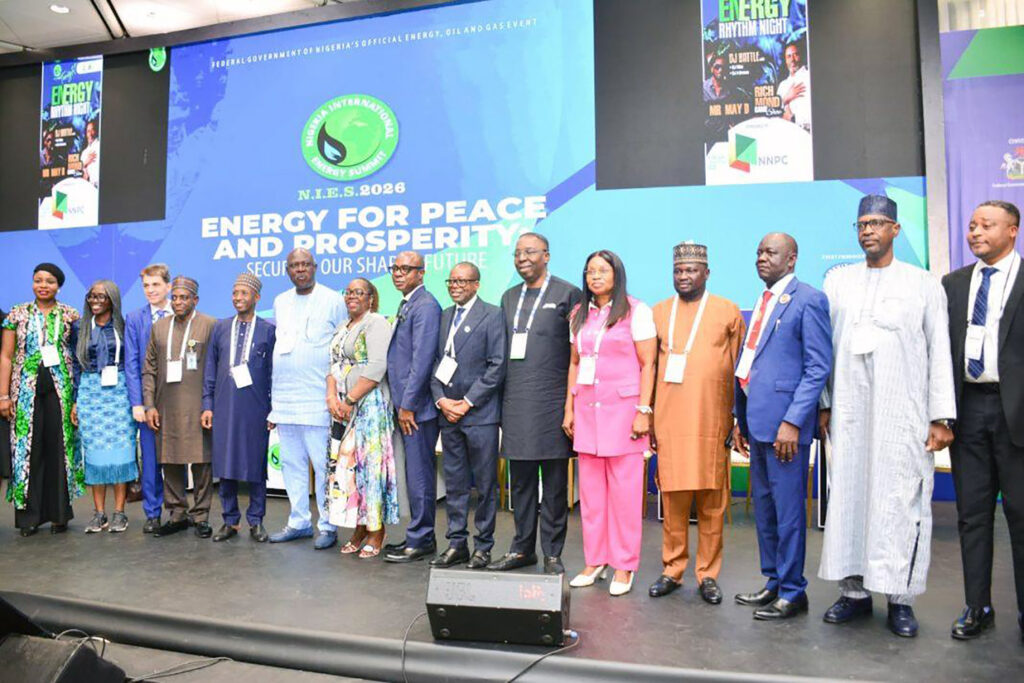
The 9th edition of the Nigeria International Energy Summit (NIES) 2026 did more than convene industry stakeholders in Abuja; it articulated an ambitious continental doctrine. Under the theme “Energy for Peace and Progress: Securing Our Shared Future,” the summit moved beyond ceremonial declarations to frame energy as the decisive lever for Africa’s economic transformation. The communiqué issued at the close of proceedings reads less like a routine conference summary and more like a policy manifesto, positioning sovereignty, industrialisation, financing reform, and regional integration at the core of Africa’s next development phase.
Held at the State House in Abuja, NIES 2026 assembled African Heads of State, global energy executives, financiers, regulators, contractors, and innovators. The presence of President Bola Ahmed Tinubu, represented by Vice President Kashim Shettima, alongside continental leaders including Adama Barrow of The Gambia and Teodoro Obiang Nguema Mbasogo of Equatorial Guinea, signalled that energy diplomacy is increasingly intertwined with Africa’s geopolitical recalibration. The summit’s message was clear: Africa must transition from a continent of raw resource exporters to a bloc of industrial value creators.
Energy Sovereignty as Economic Strategy
At the heart of the communiqué lies a powerful concept: energy sovereignty. Delegates reaffirmed the collective resolve to harness Africa’s vast hydrocarbon and renewable resources not as mere commodities for export, but as strategic instruments of domestic industrial growth and regional stability.
For decades, African economies have relied heavily on crude exports while importing refined products, petrochemicals, and even basic industrial inputs. This structural imbalance has entrenched fiscal vulnerability and exposed nations to external price shocks. NIES 2026 challenged this paradigm, urging governments to prioritise domestic value chains over crude exports.
Energy sovereignty, as articulated at the summit, is not isolationism. Rather, it is about strengthening intra-African trade, building refining and petrochemical capacity, and anchoring industrialisation on reliable, affordable energy. It means transforming oil wells and gas fields into manufacturing ecosystems, fertiliser plants, modular refineries, gas-based industries, and power generation hubs.
The endorsement of the “Abuja Pact” marked a pivotal step. It underscored a shared commitment to operationalise the African Energy Bank by mid-2026 as a financing vehicle capable of reducing dependency on external capital markets and development finance institutions whose risk appetites often constrain African projects.
Financing Reform: The African Energy Bank as Catalyst
Financing remains the Achilles’ heel of Africa’s energy ambitions. Despite abundant reserves, Nigeria alone holds an estimated 37 billion barrels of oil and 209 trillion cubic feet of gas; capital scarcity, high borrowing costs, and perceived political risk have slowed project execution.
The proposed Africa Energy Bank (AEB), headquartered in Abuja with an initial capitalisation of $5 billion, aims to rewrite this narrative. According to Farid Ghezali, Secretary General of the African Petroleum Producers’ Organization (APPO), the bank is projected to mobilise up to $200 billion for midstream and downstream investments by 2030.
The AEB’s model reflects an understanding that Africa’s energy transition will require pragmatic, phased financing, not abrupt divestment from hydrocarbons. Ghezali outlined plans to raise $15 billion within three years by listing major national companies and midstream projects. This hybrid financing approach, blending sovereign backing with market instruments, could de-risk investments and crowd in private capital.
If executed effectively, the AEB could become a cornerstone of intra-African financial integration, supporting pipelines, refineries, gas processing plants, storage terminals, and power infrastructure. Crucially, it could anchor energy financing decisions within African strategic priorities rather than external climate or geopolitical agendas.
Regulatory Clarity and the Petroleum Industry Act
No financing reform can succeed without regulatory credibility. Nigeria’s implementation of the Petroleum Industry Act (PIA) featured prominently in summit deliberations. President Tinubu emphasised that the PIA has restored investor confidence, strengthened governance, and clarified fiscal terms.
When the current administration assumed office, Nigeria’s oil production was in decline, investments had stalled, and regulatory uncertainty had dampened investor enthusiasm. By 2026, however, signs of recovery were evident. Average crude output rose to approximately 1.6 million barrels per day, with aspirations to reach 2.5 million barrels per day by 2027 and 3 million barrels per day within five years.
Senator Heineken Lokpobiri, Minister of State for Petroleum Resources (Oil), attributed recent gains to decisive reforms and initiatives such as “Project One Million Barrels Per Day.” Active rig counts reportedly increased from 14 in 2023 to over 60, while Nigeria accounted for four of the seven major final investment decisions (FIDs) announced in Africa between 2024 and 2025.
On the gas front, Rt. Hon. Ekperikpe Ekpo reported production averaging 7.5 to 7.6 billion standard cubic feet per day in 2025, alongside notable reductions in gas flaring. These figures reflect incremental progress toward Nigeria’s long-term goal of 12 billion cubic feet per day by 2030.
However, industry stakeholders cautioned that regulatory reform must go deeper. Adegbite Falade, Chairman of the Independent Petroleum Producers Group (IPPG), called for streamlined bureaucracy and rationalised fees, arguing that multiple levies still erode project economics. Regulatory consistency, transparent pricing frameworks, and predictable fiscal regimes remain critical to sustaining momentum.
Refining and Regional Integration: The Gulf of Guinea Vision
One of the most compelling aspects of NIES 2026 was its endorsement of Nigeria’s aspiration to become the refining hub of the Gulf of Guinea. Historically, West African nations have depended on imported refined products despite being major crude producers. This paradox has drained foreign exchange reserves and constrained domestic industrial growth.
Delegates lauded efforts to increase in-country refining capacity and develop cross-border gas infrastructure. Expanded refining not only reduces import dependence but also stimulates petrochemical industries, fertiliser production, and manufacturing.
Regional integration was framed as both an economic and geopolitical imperative. By exporting refined products and gas to neighbouring countries, Nigeria can strengthen regional supply security, deepen trade ties, and enhance diplomatic leverage. Energy interdependence fosters stability, a critical objective in a region grappling with security challenges and economic volatility.
Infrastructure Optimisation and Market Governance
Energy infrastructure is the physical backbone of sovereignty. The communiqué highlighted the revitalisation of Nigeria’s pipeline network, modernisation of storage and distribution systems, and diversification of the energy mix as essential pillars.
Decades of underinvestment and vandalism have weakened pipeline infrastructure, undermining production targets and increasing operational costs. Rehabilitating these assets, while deploying advanced monitoring technologies, could significantly reduce losses and improve reliability.
Market governance emerged as another priority. Delegates stressed the need for credible market data, independent regulatory oversight, and transparent pricing frameworks. Investor confidence hinges not only on geological potential but on institutional integrity.
The call for independent regulation aligns with broader continental reforms. Predictable rules lower risk premiums and attract long-term capital. In an era where global investors scrutinise governance metrics as closely as resource volumes, regulatory credibility is an economic asset.
Local Content Beyond Compliance
A landmark plenary session titled “Local Content Beyond Compliance: Building African Industrial Powerhouses” underscored a critical shift in discourse. For years, local content policies have been framed as compliance obligations. NIES 2026 reframed them as strategic development tools.
Participants from the Petroleum Technology Association of Nigeria (PETAN), the Petroleum Contractors Trade Section (PCTS), the Oil Producers Trade Section (OPTS), and global firms debated regulatory harmonisation, cost optimisation, and merit-based contracting.
The consensus was clear: sustainable growth depends on collaboration and competence. Local content must evolve from quota-based requirements to performance-driven industrial partnerships. Technology transfer, capacity utilisation, and skills development are essential for building competitive African firms capable of operating across borders.
Solewant Group: Indigenous Capacity in Action
Among the industry players exhibiting at NIES 2026, Solewant Group stood out as a case study in indigenous industrial evolution. Over 25 years, the company has transformed from a modest pipeline coating service provider into a fully integrated energy-services conglomerate.
Through subsidiaries such as Solewant Nigeria Limited (SNL), Field Joint Coatings Limited (FJCL), Solewant Specialty Protective Coatings & Paints Limited (SSPC), Pipe & Metals Industries Limited (PMI), and the Solewant Energy Training Institute (SETI), the group showcased solutions spanning steel pipe manufacturing, multi-layer coating technologies, cathodic protection systems, pipeline engineering, and manpower training.
Solewant’s trajectory mirrors the summit’s vision: retaining maximum value in-country. By investing in manufacturing, fabrication, and training, the company reduces import dependence and builds technical expertise within Nigeria. Its participation reinforced the argument that indigenous capacity, when supported by policy clarity and financing access, can anchor Africa’s industrial transformation.
Energy Security and Regional Leadership
Energy security extends beyond production volumes. It encompasses reliability, affordability, environmental standards, and regional support mechanisms. Nigeria’s ambition to emerge as a regional energy hub hinges on fulfilling domestic supply obligations while exporting surplus capacity.
Group Chief Executive Officer of Nigerian National Petroleum Company Limited (NNPC), Bayo Ojulari, framed Nigeria as an emerging global energy powerhouse. Yet he acknowledged persistent challenges: over 600 million Africans lack access to electricity. Accessibility and affordability remain central concerns.
Harnessing gas for power generation offers a pragmatic pathway. Gas-to-power projects can stabilise grids, support industrial clusters, and reduce reliance on diesel generation. Coupled with regional interconnections, they can anchor cross-border electricity trade.
Enforcing international fuel quality standards was also emphasised. Cleaner fuels improve public health and environmental outcomes while aligning African markets with global benchmarks.
From Policy Frameworks to Measurable Progress
The concluding section of the communiqué declared a strategic pivot toward energy sovereignty, industrial value creation, and robust regional cooperation. The ambition is bold: harmonise policy intent with capital mobilisation, regulatory integrity, and infrastructure execution.
However, translating vision into measurable progress requires sustained political will. Production targets must be matched by infrastructure upgrades. Financing pledges must materialise into disbursed funds. Regulatory reforms must endure beyond electoral cycles.
NIES 2026 signalled that Africa’s energy discourse is maturing. Rather than framing hydrocarbons as relics of the past, the summit positioned them as transitional assets capable of funding diversification and industrial growth. Simultaneously, it acknowledged the imperative of sustainability and gas-based transitions.
For Nigeria, the summit reinforced its dual identity: a national reformer and a continental convener. By hosting African leaders and endorsing the Africa Energy Bank, Nigeria asserted its aspiration to shape regional energy governance.
The challenge now lies in execution. If the commitments articulated in Abuja are realised, if the Africa Energy Bank mobilises capital, if regulatory reforms deepen, if indigenous firms scale, and if infrastructure projects accelerate, NIES 2026 may be remembered as a turning point.
Energy for peace and prosperity is more than a theme. It is a strategic thesis: that stable, affordable, and industrially integrated energy systems can underpin economic resilience, reduce poverty, strengthen regional ties, and position Africa as a confident actor in global energy markets.
The communiqué stands as a declaration of intent. The next chapter will be written not in conference halls, but in pipelines laid, refineries commissioned, gas processed, power generated, and jobs created across the continent.
