…Lagos, Jigawa Account For Highest Spending With N1.63bn
…Borno Records Lowest Spending At N36.41m
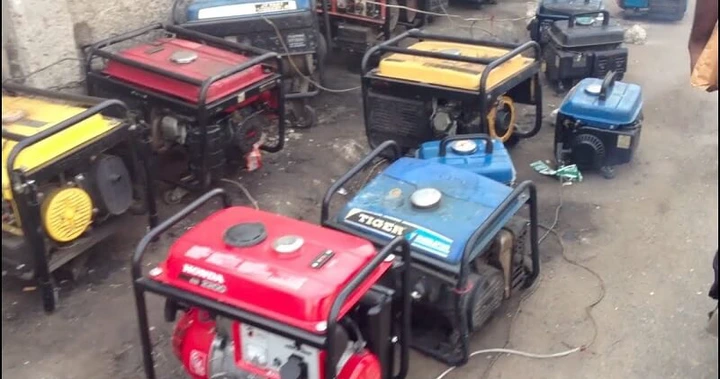
Fifteen state governments spent a combined N3.47bn on the maintenance of plants and generators in the first six months of 2026, highlighting the continued dependence of public institutions on alternative power sources amid Nigeria’s persistent electricity crisis.
The expenditure was contained in the second-quarter 2026 budget implementation reports of the 15 states reviewed by THE WHISTLER, which showed that the states collectively budgeted N13.77bn for plant and generator maintenance for the year.
By the end of Q2, the states had spent about 25.2 per cent of their combined annual allocations, leaving more than N10.30bn unspent.
Kano recorded the highest budget implementation rate at 55.3 per cent, having spent N306.43m out of its N554.15m allocation.
Edo followed with 52.2 per cent, after spending N219.22m from its N419.76m budget, while Jigawa recorded 46.4 per cent, spending N1.05bn from its N2.27bn allocation.
Adamawa posted 40.4 per cent, with N151.90m spent from a revised budget of N376.16m. Its original budget for the item was N283.51m.

Nasarawa spent N208.94m from its N903.65m allocation, representing 23.1 per cent implementation, while Benue spent N118.64m from its N477.11m budget, or 24.9 per cent.
Enugu recorded 22.2 per cent, having spent N43.24m from its N194.50m allocation.
Lagos, which had the largest annual allocation among the states reviewed, budgeted N2.83bn for plant and generator maintenance. The state spent N578.31m by the end of Q2, representing 20.4 per cent of its annual provision.
Kaduna also recorded 20.4 per cent implementation, spending N124.97m from its N614.06m allocation.
Ogun spent N144.48m from its N837.51m budget, representing 17.3 per cent, while Imo spent N184.90m from its N1.11bn allocation, or 16.6 per cent.
Plateau recorded 15.3 per cent implementation after spending N68.61m from its N448.57m allocation.
Cross River spent N144.13m from its N1.16bn budget, representing 12.5 per cent, while Bayelsa recorded 11 per cent after spending N90.54m from its N821.06m allocation.
Borno had the lowest implementation rate, spending only N36.41m from its N840.42m allocation, representing 4.3 per cent.
In terms of actual expenditure, Jigawa recorded the highest spending at N1.05bn, followed by Lagos with N578.31m and Kano with N306.43m. Together, Jigawa and Lagos accounted for about N1.63bn of the N3.47bn spent by the 15 states.
At the other end, Borno’s N36.41m was the lowest amount spent, followed by Enugu with N43.24m and Plateau with N68.61m.
The expenditure comes despite years of federal interventions aimed at improving Nigeria’s electricity generation, transmission and distribution infrastructure.
One of the major interventions is the Presidential Power Initiative (PPI), developed in partnership with Siemens AG. The Nigerian Government and Siemens signed a Letter of Agreement on the Nigerian Electrification Roadmap in July 2019 to modernise and expand the electricity network.
The initiative was structured around targets to raise operational capacity to 7,000MW, 11,000MW and ultimately 25,000MW through successive phases. The project was initially expected to reach the 25,000MW target by 2025, while the Federal Government and Siemens signed a contract for its pre-engineering phase in February 2021.
The Federal Executive Council also approved €15.21m, equivalent to N6.94bn at the time, for the offshore component of Nigeria’s counterpart funding for the project, alongside N1.708bn for the onshore component.
However, the 25,000MW target was not achieved by 2025.
The Federal Government has continued implementing parts of the project. In November 2025, the Presidency said Siemens Energy had delivered and commissioned 10 units of 132/33kV mobile substations and transformers, adding 984MW of transmission capacity to the grid.
The second phase of the Siemens project also commenced in 2025, focusing on expanding transmission capacity and improving the grid’s ability to evacuate electricity.
In April 2026, the Federal Government confirmed that construction of a new 330/132kV transmission substation in Abeokuta, Ogun State, under the PPI was progressing and was scheduled for completion by December 2026.
Despite these interventions, Nigeria’s installed generation capacity of more than 13,000MW remains significantly above the electricity available to consumers, with gas supply, generating plants, transmission infrastructure and distribution networks continuing to constrain supply.
The shortfall has sustained reliance on self-generation, particularly for public institutions that require alternative power sources when grid supply is inadequate.
The N3.47bn spent by the 15 states therefore reflects the continuing cost of maintaining alternative electricity sources while longer-term investments in the national power infrastructure are being pursued.
Lagos provided the largest allocation at N2.83bn, followed by Jigawa with N2.27bn. Other sizeable provisions included Imo’s N1.11bn, Cross River’s N1.16bn, Borno’s N840.42m, Ogun’s N837.51m, Bayelsa’s N821.06m and Nasarawa’s N903.65m.
For the states, maintaining existing generating equipment provides a means of sustaining public services when grid electricity is unavailable or inadequate. However, the recurring expenditure also represents a cost that could otherwise be deployed to other public needs if electricity supply were more reliable.
With more than N10.30bn of the combined annual allocations still unspent at the end of Q2, plant and generator maintenance is likely to remain a significant component of state expenditure through the rest of 2026.
The Minister of Power, Joseph Tegbe, had on Wednesday said some electricity consumers had asked him to “slow down” with ongoing improvements in power supply, joking that their freezers were now working continuously.
Tegbe disclosed this in Abuja at the commissioning of the 3-megawatt solar hybrid power project at Yakubu Gowon University, formerly the University of Abuja.
According to the minister, consumers in some parts of the country had begun experiencing significant improvements in electricity supply following recent interventions by the Federal Government.
“Places that didn’t have light at all for three months are now having 18 hours of light.
Some areas called me to say, look, I should slow down, that everything in their freezer is freezing.
“That is what a freezer is meant to do. Let it freeze the food that needs to be frozen,” Tegbe said.
The minister recalled that he had promised during his Senate screening that Nigerians would begin to notice improvements in electricity supply within three to six months.
He, however, acknowledged the age and condition of the nation’s electricity infrastructure, noting that some facilities in the sector were more than 40 years old.
“Some of the infrastructure we have in the electricity and power sector is more than 40 years old. We’re systematically replacing them, phasing them out and bringing new ones,” he said.
SOURCE: The Whistler
