

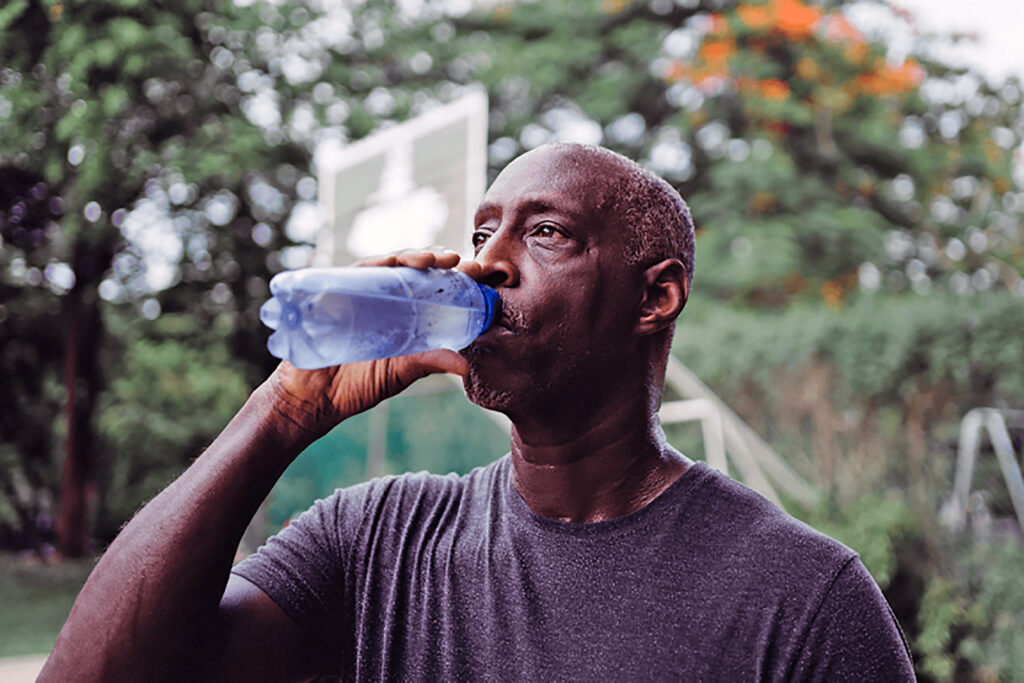
By Anastasia Adaeze
THE DAY KOFI FINALLY LISTENED TO HIS BODY
Kofi used to laugh at people who carried water bottles everywhere. “Are you going to the gym or just walking down the street?” He would tease.
Life in Kumasi moved fast, and Kofi moved faster. Engines to fix, customers to attend to, bills to pay. Under the hot Accra sun, sweat clung to his skin like a second shirt, but water? That was an afterthought. If he remembered, he would grab a sachet. If not, the day went on.
At first, it was small things, a headache that lingered longer than usual. A kind of tiredness sleep did not fix, moments where his vision blurred slightly, like his body was buffering. Still, he ignored it. Because that is what many of us do, we normalise discomfort. Until one afternoon, everything slowed down. The noise of the workshop faded. The voices blurred. His hands lost their strength. And then, darkness. When he woke up at the clinic, there was no dramatic diagnosis waiting for him. No complicated explanation, just a nurse who looked at him with calm certainty and asked, ‘How much water do you actually drink?’
He did not have a good answer, and that was the point. Kofi did not collapse because of something rare or mysterious. He collapsed because of something ordinary, something we all overlook because it feels too simple to matter: water.
There is a quiet intelligence in the human body. It does not shout immediately; it whispers first. Fatigue is a whisper. Dry lips are a whisper. That slight headache at the back of your head? Another whisper. Science has simply confirmed what the body has always known. The human body is made up of roughly 60 per cent water. Not just in a general sense, but deeply woven into everything that keeps you alive: your blood, your brain, your muscles. Water is the medium through which your body communicates, transports nutrients, regulates temperature, and removes waste.
Without enough of it, things do not just “pause”; they begin to decline.

Research in hydration science has shown that even mild dehydration, losing as little as 1 to 3 per cent of your body’s water, can begin to affect how you think and feel. Your concentration dips. Your mood shifts. Tasks that once felt easy start to feel heavier, slower, and more frustrating.
It’s subtle, but it’s also very real. Your brain, which is about 75 per cent water, is especially sensitive to these changes. When you’re dehydrated, it doesn’t function at full capacity. Memory becomes less sharp. Focus slips. You may even feel more anxious or irritable without understanding why. And yet, we rarely connect the dots, always blaming stress, blaming people; we even blame life. Meanwhile, the body is quietly asking for something as simple as water.
In West Africa, water should be taken seriously, not just culturally but physically; the climate alone demands it. The heat is not gentle. It pulls moisture from your body constantly, through sweat you can see, and through evaporation you can’t. If you work outdoors, commute long distances, or even spend hours in poorly ventilated spaces, your body loses water faster than you realise.
Still, many of us don’t adjust; we wake up and rush out, drinking soft drinks because they feel satisfying, then we postpone water, always treating it as an option. But hydration is not optional in this environment; it is essential.
Global public health research, including reports from the World Health Organization, highlights how access to safe drinking water is still a challenge for billions of people. But beyond access, there is also awareness. Even where water is available, it is often undervalued.
And that has consequences. Dehydration does not always show up dramatically. Sometimes, it appears as reduced productivity. Slower thinking. Increased fatigue during the day. More frequent illness. Over time, it can strain the kidneys, affect digestion, and make everyday life feel harder than it should.
Water supports everything quietly. It keeps your blood flowing smoothly. It helps your body cool itself efficiently. It allows your kidneys to filter waste without stress. It supports digestion so your body can actually use the food you eat.
In a way, water is the background system of your life, the thing you don’t notice until it starts failing.
After that day at the clinic, Kofi did not become a completely different person. He did not suddenly carry a fancy bottle or start measuring litres. He just started paying attention.
In the mornings, before stepping out, he drank water. Not because it was trendy, but because he remembered how he felt lying on that clinic bed.
During work, he kept sachets nearby. When the sun felt harsh, he didn’t argue with his body anymore. He listened, and slowly things changed.
The headaches did not come as often. The heavy tiredness lifted; he felt more present, more alert, more himself. It was not dramatic; it was steady. That is the thing about water: it doesn’t transform your life overnight. It restores it quietly. For you, it might start even smaller.
A glass of water when you wake up. Another before you eat. A conscious choice to drink water before reaching for something else.
No pressure, no perfection, and just awareness. Because the truth is, your body is already doing everything it can to keep you going. The least you can do is give it what it’s been asking for all along.
So the next time you feel off, tired, unfocused, or slightly irritated for no clear reason, pause for a moment.
Not to overthink, but to ask a simple question: When last did I drink water? And then, without overcomplicating it, drink water. Not because it’s advice, not because it’s a rule. But because somewhere inside you, your body has been waiting for that moment.
