

By Ese Ufuoma
In many farming communities across Africa, land has always meant one thing: survival. It is where families plant maize, cassava, rice, cocoa, groundnuts, and hope that the rains cooperate. It is where seasons are measured not by policy targets or carbon reports, but by hunger, harvest, and the price of fertiliser at the local market.
Now, a new conversation is slowly entering those same farmlands. It sounds unfamiliar at first: carbon credits, carbon farming, net zero. But it is beginning to sit alongside the older, more urgent language of agriculture. And for the first time, farmers are being told that the air above their farms, and the soil beneath their feet, may have a price. The idea is simple on paper. When farmers adopt practices that keep more carbon in the soil or reduce emissions, those changes can be measured and turned into credits. Those credits can then be sold to companies in other parts of the world, trying to balance out their own emissions.
What this means in practice is that farming is no longer only about what is harvested from the land. It is also about what the land can hold back from the atmosphere.
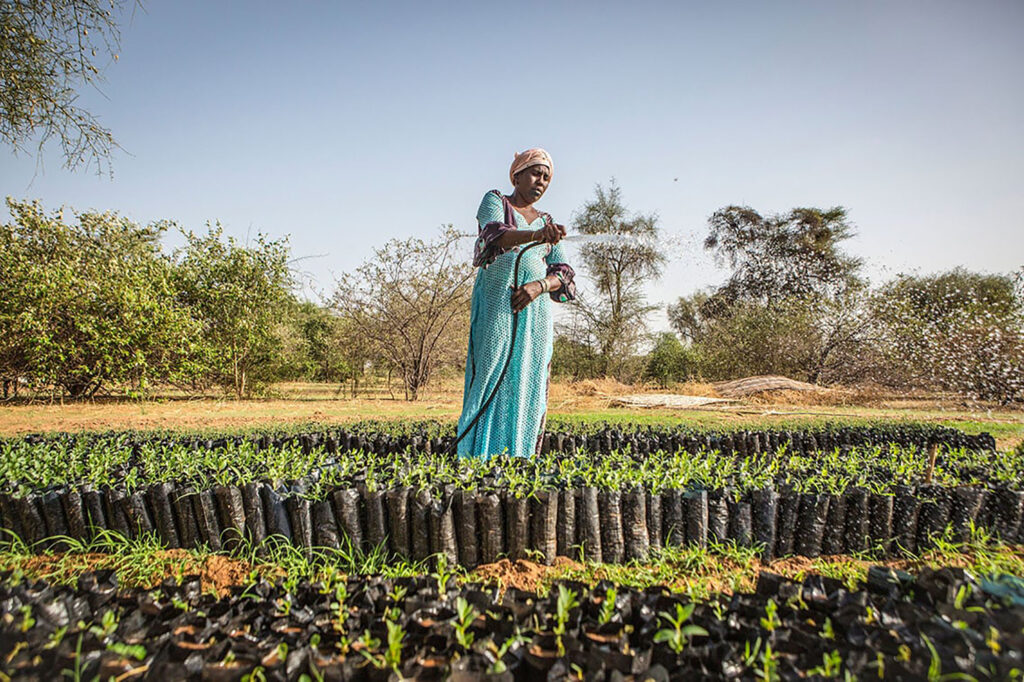
Across countries like Kenya, Ghana, Zambia, and Nigeria, pilot projects are already testing this system. Some involve smallholder farmers planting trees alongside crops. Others focus on reducing burning, improving soil cover, or changing grazing patterns. NGOs and private companies often provide the tools, training, and measurement systems needed to track the carbon changes; for farmers, the promise is additional income, paid separately from crop sales. In places where farming margins are already tight, that promise carries weight. But the system is not as straightforward as it sounds.
Unlike maize or cocoa, carbon cannot be seen in sacks or measured at the edge of a farm. It is calculated through models, soil tests, satellite data, and long-term monitoring. Most farmers do not interact with the carbon market directly. They sign agreements with intermediaries who manage the process, measure the carbon, and sell the credits abroad.
This is where the questions begin: who decides what a tonne of carbon is worth? Who controls the data?
And how much of the final value actually returns to the farmer who changed their land use in the first place

In some projects, farmers receive small but steady payments over several years. In others, the benefits are less clear, buried in contracts that stretch far into the future. The difference often depends on the organisation running the programme and the strength of local oversight.
Still, the interest is growing. Global demand for carbon credits has risen as companies face pressure to meet climate targets. Aviation, energy, manufacturing, and tech firms are among the biggest buyers. For them, land-based carbon removal projects in Africa are attractive because they are cheaper than many industrial alternatives. For African agriculture, this has created a new kind of attention. Not just as a food-producing sector, but as a climate asset.
In Nigeria, where agriculture already struggles with climate stress, from drought in the north to flooding in parts of the south, the idea of paying farmers for climate-friendly practices is gaining traction in policy and development circles. Regenerative agriculture, once a niche concept, is now being discussed alongside food security and rural income.
But on the ground, the transition is uneven; many farmers are still trying to understand what they are being enrolled into. Others see it as just another programme that arrives with promises, training sessions, and forms to sign. The difference this time is that the product being discussed is invisible, and the market for it sits far outside the village economy.
There is also a deeper concern: if farmland begins to generate income from carbon, who owns that carbon? The farmer, the community, or the company that measures it. Land in many African regions is already layered with complex tenure systems. Adding a global commodity on top of that complexity raises new legal and ethical questions that are only beginning to surface.
Despite all this, carbon farming is not slowing down. More agritech firms, climate funds, and development agencies are entering the space. Governments are beginning to explore frameworks for carbon accounting in agriculture. And international buyers are actively looking for large-scale land-based projects that can deliver measurable climate benefits.
What is emerging is a second layer of agriculture, running alongside food production. One that is not sold in local markets but in international carbon registries. One that is not weighed in bags but verified in data sets. One that does not replace crops, but redefines what farmland is worth
For African farmers, the opportunity is real, but so is the uncertainty, because for the first time, the value of their land is being calculated not only by what it feeds but also by what it prevents from entering the sky. And that is a very different kind of harvest.
