

The Nigerian stock market will today begin implementation of a new pricing methodology under which the market price of a particular share will determine the number of shares needed to effect movement in the share price.
The new pricing framework replaces the previous universal rule that stipulated a single minimum trade quantity to change prices for all categories of quoted equities.
Under the new revised pricing methodology framework approved by Securities and Exchange Commission (SEC), tiered minimum traded quantity thresholds will apply for published price movements, based on the prevailing share price of each security at the Nigerian Exchange (NGX).

Quoted equities will be classified into three categories of share prices trading at N1,000 and above, between N500 and N999.99 and below N500. For the first category, minimum units of shares for price movement will be 10,000 shares, while the second and third categories require 50,000 units and 100,000 units respectively.
The new methodology was designed to strengthen price discovery by ensuring that transactions of material economic value are appropriately reflected in published market prices, while maintaining safeguards against price distortion.
There were concerns that the new pricing methodology could lead to volatility in share prices in the weeks ahead as the market adjusts to the new operating rule.
Analysts at Cordros Capital said the revised pricing methodology would be one of the moderating influence on market volatility in the near-term.
Analysts also highlighted that remaining half year 2026 results and FTSE Russell’s final decision on Nigeria’s frontier market status would also influence trading pattern.

According to analysts, prospective dividend declarations by large-cap banking stocks could drive stock-specific positioning while investor sentiment could also be influenced by developments surrounding FTSE Russell’s final decision on Nigeria’s potential reclassification to frontier market status, following the earlier suspension due to the market moving to a shorter settlement cycle.
“Overall, we expect the market to trade cautiously as investors weigh near-term headwinds and tailwinds,” Cordros Capital stated.
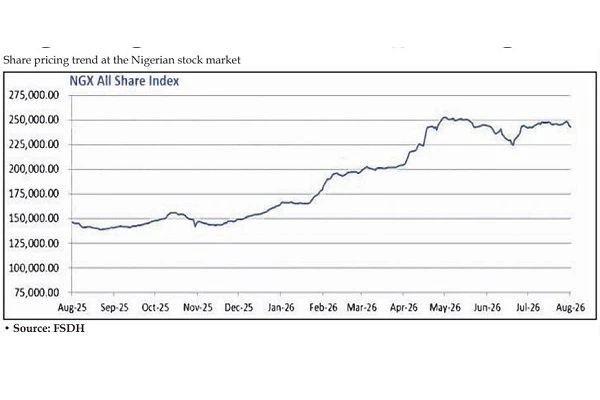
The benchmark pricing index at the NGX, the All Share Index (ASI) declined by 1.20 per cent to close weekend at 242,619.20 points amid widespread selloffs across sectors and stock categories.
Aggregate market value of all quoted equities also depreciated by 1.19 per cent to N156.624 trillion, highlighting a bearish market that saw 26 gainers against 59 losers during the week.
Total turnover stood at 12.153 billion shares worth N176.058 billion in 224,146 deals as against 5.359 billion shares valued at N139.053 billion traded in 261,869 deals two weeks ago.
SEC had last week stipulated that transactions at the Nigerian stock market must be fully paid not later than 5.00 p.m. on the first business day after the transaction in a definitive move that ensures that investors get full value for their transactions within a strictly defined period.
The deadline redefines the T+1 settlement cycle, which ordinarily stipulated that transactions at the market must be settled a day after the transaction day.
According to SEC, the new deadline was part of the implementation of the T+1 settlement cycle in the Nigerian capital market.
SEC emphasised that all transactions in equities and commodities must be fully paid by 5:00 p.m. T+1 to ensure compliance with the standard Delivery versus Payment (DvP) settlement procedure.
The commission warned that where a broker or dealer’s trading account was not adequately funded to meet its settlement obligation within the prescribed period, the default would be managed in line with the Central Securities Clearing System (CSCS) Default Management Procedure and the applicable transaction settlement guidelines of the relevant exchange.
SEC however clarified that foreign portfolio investors are not required to prefund their accounts for trades in the Nigerian capital market, noting that capital market operators facilitating transactions on behalf of foreign portfolio investors must establish and maintain appropriate controls and processes to ensure timely funding and completion of settlements within the prescribed timeframe.
“The clarification follows earlier SEC circulars on the implementation of the T+2 settlement cycle for equities transactions, issued on June 3, 2025, and the transition to the T+1 settlement cycle, issued on May 15, 2026. The T+1 cycle means that eligible securities transactions are settled one business day after the trade date, reducing the period between execution and final settlement,” SEC stated.
The commission had described the transition as a significant milestone in its efforts to build a more efficient, resilient and internationally aligned trading and post-trade environment.
According to SEC, shorter settlement cycle would improve settlement efficiency, reduce counterparty risk, enhance liquidity and strengthen the competitiveness of the Nigerian capital market.
SEC noted that the reforms would ultimately improve the attractiveness of the Nigerian market to both domestic and international investors.
Nigeria had on June 1, 2026 made history as the first African country to shorten transaction settlement cycle at its stock market to two days, a milestone that was expected to enhance liquidity and global competitiveness of the Nigerian market.
SOURCE: The Nation Nigeria
