

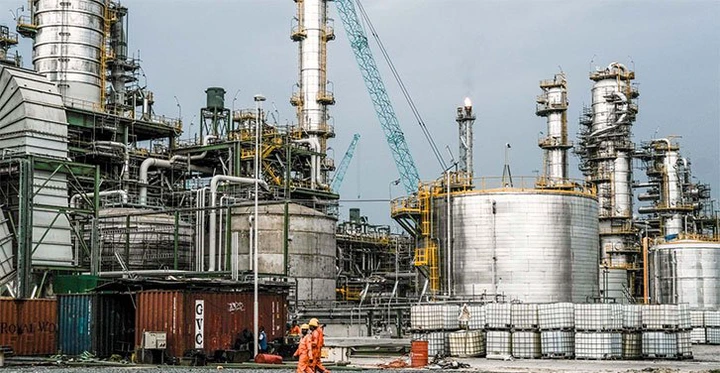
Nigeria’s energy sector is entering another decisive phase, marked by a striking contradiction: the country is increasingly capable of producing energy commodities for international markets, yet domestic businesses and consumers continue to struggle with the cost and availability of those same products.
The contradiction is perhaps most visible in aviation fuel.
The Dangote Refinery has emerged as a major supplier of aviation turbine fuel to Europe, becoming the continent’s largest supplier for a second consecutive month, even as Nigerian airlines confront fuel costs that are placing enormous pressure on their finances.

The development captures a fundamental weakness in Nigeria’s liberalised energy market. Production capacity alone does not guarantee affordability at home.
Nigeria is producing aviation fuel on a scale sufficient to make it a major exporter, but its domestic airlines are struggling to secure the product at prices that allow them to operate competitively.
Nigerian airlines are estimated to have accumulated more than N60 billion in bank loans largely to meet high aviation fuel costs. The financial burden is particularly severe because aviation fuel represents one of the largest operating expenses for airlines, making any sustained increase in its price immediately visible in ticket prices, profitability, working capital and debt-servicing capacity.
The situation raises an uncomfortable question: how can a country become a major exporter of jet fuel while its own airlines struggle with the cost of aviation fuel?
The answer lies partly in the structure of Nigeria’s downstream market.

The Dangote Refinery operates within a liberalised market. Its products are generally priced with reference to market conditions and international parity rather than being sold to domestic consumers at a preferential price simply because they are Nigerian.
That means Nigerian airlines compete for supply on commercial terms with international buyers.
International airlines with greater purchasing volumes, stronger balance sheets and direct relationships with refiners can have significant negotiating advantages. Nigerian carriers, by contrast, largely obtain aviation fuel through petroleum marketers operating the tank-farm and airport supply infrastructure.
The result is that domestic airlines may be physically closer to the refinery but economically less competitive in accessing its products.
This is one of the unintended consequences of liberalisation.
A liberalised market can improve efficiency, encourage investment and eliminate the distortions associated with government-controlled pricing. But liberalisation does not automatically guarantee that domestic industries will receive strategic commodities at prices that support their competitiveness.
Nigeria has effectively become a net exporter of aviation fuel. Bringing in imported jet fuel simply to create additional competition would make little economic sense when domestic production already exceeds consumption.
The country would essentially be importing a product that it produces in surplus, while simultaneously exporting the same product to markets willing to pay a premium.
The policy challenge, therefore, is not simply increasing production. It is improving the mechanisms through which domestic demand connects with domestic supply.
That could involve more transparent pricing mechanisms, stronger supply contracts, improved airport storage and distribution infrastructure, greater direct purchasing capacity for airlines and policies that encourage refiners and domestic carriers to establish sustainable commercial relationships.
But any intervention must be carefully designed.
Artificially forcing refiners to sell below market prices could recreate the distortions associated with the subsidy regime and discourage investment. On the other hand, leaving the entire system to market forces without addressing structural disadvantages facing domestic airlines could weaken an industry that is strategically important to Nigeria’s economy.
The aviation fuel crisis therefore presents policymakers with a delicate balancing act: preserving the commercial viability of refineries while preventing domestic airlines from being priced out of the market.
The irony becomes even sharper when compared with petrol.
Unlike aviation fuel, petrol continues to have an import component. NNPC imported about 18.1 million litres of petrol per day in June, reportedly the highest monthly level since January 2026.
Petrol imports provide another source of supply and can influence domestic market dynamics.
Aviation fuel has no comparable alternative.
Nigeria is producing the commodity domestically in surplus, meaning the solution cannot simply be to increase imports. The real issue is how to ensure that the domestic market captures more of the economic value generated by the country’s expanding refining capacity.
This debate comes as the Federal Government pursues an equally ambitious strategy on the upstream side of the energy industry.
President Bola Tinubu has approved new incentives designed to attract as much as $50 billion in investment into Nigeria’s deepwater oil and gas sector.
The new framework seeks to address one of Nigeria’s biggest energy-sector problems: declining investment in upstream production despite the country’s enormous hydrocarbon reserves.
Under the new executive order, qualifying deepwater projects will receive a Standard Production Tax Credit.For oil fields with reserves below 400 million barrels of oil equivalent, operators qualify for a credit of $3 per barrel or 20 per cent of the fiscal oil price, whichever is lower, subject to a cap covering the first 150 million barrels produced.
For larger fields with reserves above 400 million barrels, the credit rises to $4.50 per barrel or 20 per cent of the fiscal oil price, subject to the first 500 million barrels produced.
The incentives apply to projects reaching final investment decision between August 10, 2026 and December 31, 2029 on existing leases.
The government has also introduced incentives for non-associated gas developments, with different credits depending on the quality of the gas.
The structure is designed to alter the economics of projects that have previously been considered too expensive, risky or commercially unattractive.
That is critical because Nigeria’s deepwater oil industry requires enormous upfront capital.
Projects such as Bonga, Agbami, Akpo and Egina have demonstrated the country’s capacity to produce significant volumes from offshore fields. But many newer developments have remained delayed as international oil companies reassess capital allocation, fiscal terms, project economics and the global transition away from hydrocarbons.
The Bonga South West project, estimated at about $10 billion, is perhaps the clearest test of whether the new incentives can unlock investment.
International investors will also examine security, regulatory certainty, contract enforcement, infrastructure, fiscal stability, local-content requirements and the speed with which government agencies approve projects.
The credibility of the new incentives will ultimately be determined by implementation.
There is also an important connection between the upstream reforms and another major government ambition: the proposed listing of NNPC on the Nigerian Exchange.
The government has revived plans to list the national oil company, a move that could significantly increase the capitalisation of the NGX while potentially improving transparency, governance and accountability within Nigeria’s most important energy institution.
NNPC is simultaneously a commercial entity, a strategic national institution and an instrument of government energy policy.
The new upstream incentives make that distinction even more important.
If NNPC’s future earnings are affected by fiscal concessions, production-sharing arrangements, investment commitments and government policy objectives, investors will need substantial clarity on how these obligations will affect profitability and dividend capacity.
A listed NNPC would be expected to operate according to commercial principles, but it will inevitably remain subject to national policy considerations.
The success of the listing will therefore depend heavily on governance.
Investors will want audited accounts, transparent related-party transactions, predictable dividend policies, clear financial obligations and a credible separation between commercial decisions and political directives.
The three developments — Dangote’s jet-fuel exports, the deepwater tax incentives and the proposed NNPC listing — appear different, but they point to the same central challenge.
Nigeria is gradually building the capacity to become a much more important energy producer.
The Dangote refinery is demonstrating that Nigeria can export refined petroleum products at scale. The deepwater incentives are designed to attract billions of dollars into crude oil and gas production. The proposed NNPC listing could transform the country’s national oil company into a much more commercially accountable institution.
The emerging energy strategy therefore requires more than investment. It requires alignment.
Refineries must be commercially viable. Domestic industries must remain competitive. Upstream investors must receive credible and stable fiscal terms. Government must earn sufficient revenue. Consumers must ultimately benefit through improved supply and pricing.
Nigeria’s energy transformation will not be measured simply by how many litres of jet fuel Dangote exports, how many billions of dollars are committed to deepwater projects or how large NNPC becomes on the stock exchange.
The real test will be whether those developments translate into a stronger domestic energy economy.
For now, Nigeria stands at an intriguing crossroads: increasingly capable of producing energy for the world, but still struggling to ensure that the benefits of that production flow efficiently through its own economy.
That is the paradox policymakers must resolve if the country’s energy renaissance is to become an economic transformation rather than simply an expansion of export capacity.
SOURCE: Independent
