

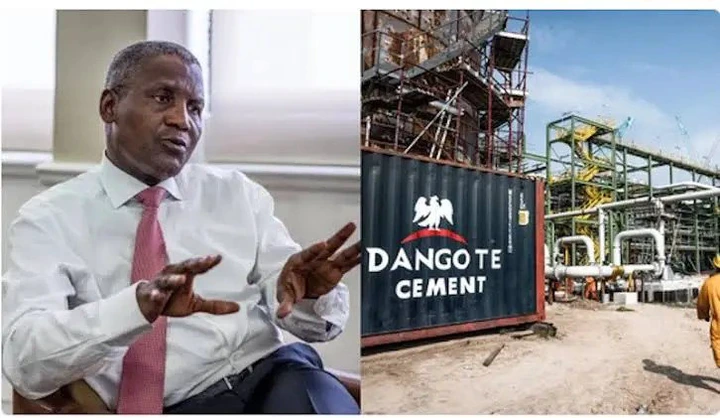
Nigeria can produce more than twice the cement it consumes, yet prices have climbed to as much as ₦15,000 per bag. The FCCPC is now investigating possible shady deals
The Federal Competition and Consumer Protection Commission (FCCPC) has opened a deeper investigation into Nigeria’s cement market after preliminary findings raised concerns about possible price manipulation and anti-competitive practices.
The regulator said its initial findings followed a three-month cross-border study triggered by widespread complaints about rising cement prices in Nigeria.

According to the Commission, a 50kg bag of cement that sold for between ₦9,300 and ₦9,700 in January 2026 rose to between ₦10,500 and ₦13,000 by mid-year.
By July, prices of between ₦13,000 and ₦15,000 were recorded in some parts of the country.
The development was disclosed in a 40-page field report compiled after a three-month cross-border study by the FCCPC’s anticompetitive practices department (ACP).
Nigeria Produces More Cement Than It Consumes
At the heart of the investigation is an unusual market contradiction.

The FCCPC estimates that Nigeria has installed cement production capacity of between 60 million and 65 million metric tonnes a year.
Domestic consumption, however, is estimated at only 25 million to 30 million tonnes. Nigeria also exports cement to neighbouring countries.
This means the country has significantly more installed production capacity than its domestic market currently requires.
The regulator said such excess capacity would ordinarily be expected to create stronger downward pressure on prices in a competitive market. But that has not happened.
Independent research has raised similar questions.
A February 2026 analysis by Agora Policy estimated Nigeria’s installed capacity at about 65 million tonnes against domestic demand of roughly 32 million tonnes.
The think tank argued that Nigeria had successfully solved its old cement supply problem but had yet to translate that capacity into the level of price competition consumers might expect.
Cement is Cheaper in Kenya, Tanzania and Togo
The FCCPC compared Nigeria with cement markets including Kenya, Tanzania, South Africa, Egypt, Morocco, Algeria and Togo.
The Commission considered limestone availability, population, production capacity, domestic consumption and retail prices. Its findings showed significant differences.
A 50kg bag of cement sells for about $5.40 in Nairobi, Kenya, which the Commission converted to approximately ₦7,344.
In Tanzania, the equivalent price was about $4.80, or ₦6,528. In Togo, a bag was priced at about $6.75, equivalent to ₦9,180.
The Togo comparison attracted particular attention because the country does not have Nigeria’s extensive limestone deposits.
Cross-country price comparisons require caution. Energy costs, taxes, transportation, exchange rates, distribution systems and plant efficiency vary considerably between markets.
The FCCPC says this is why it is now examining the underlying cost structure of Nigeria’s cement industry rather than drawing a conclusion from retail prices alone.
Cement producers blame energy, FX and logistics
Manufacturers have pointed to several reasons for high cement prices.
These include energy costs, naira depreciation, imported machinery and spare parts, transport expenses and wider logistics challenges.
The FCCPC acknowledged those pressures but said it is testing the explanations against verified information on production costs, pricing, output and capacity utilisation.
For example, BEA’s analysis of BUA Cement’s H1 2026 results showed how changes in foreign exchange, financing, energy and production costs can materially affect profitability.
BUA reported that direct cost per tonne fell 4.4% year-on-year in the first half of 2026, while improved foreign-exchange conditions and sharply lower net finance costs supported earnings growth.
The question facing the regulator is therefore not whether cement manufacturers face costs. It is whether those costs fully explain prevailing retail prices.
3 companies control more than 90% of capacity
Competition is also under scrutiny because Nigeria’s cement industry is highly concentrated.
Publicly available estimates indicate that three major companies account for more than 90% of installed cement production capacity in Nigeria.
The dominant operators are Dangote Cement, BUA Cement and HBM Nigeria Plc, formerly Lafarge Africa.
HBM adopted its new identity in June following the acquisition of Holcim’s controlling stake in Lafarge Africa by China’s Huaxin Cement. BEA previously examined what the Lafarge-to-HBM transition means for Nigeria’s cement market.
A concentrated market is not by itself evidence of wrongdoing.
But it increases the importance of competition oversight because pricing and production decisions by a small number of dominant companies can have a large effect on the entire market.
The FCCPC said all major manufacturers except one cooperated with its initial study by making records available.
It has now issued formal Notices of Commencement of Investigation and Summons to Produce to key industry participants.
The regulator is seeking information covering pricing methodologies, production, capacity utilisation, exports and commercial relationships.
Cement companies are reporting strong profits
The investigation also comes during a period of strong earnings for Nigeria’s biggest cement producers.
Dangote Cement, BUA Cement and HBM Nigeria reported a combined profit after tax of about ₦1.17 trillion in the first half of 2026, according to their financial results. That was about 40% higher than the corresponding period of 2025.
Dangote Cement alone reported H1 revenue of about ₦2.51 trillion and profit after tax of ₦638.5 billion.
BEA previously reported that Dabusinesselitesafrica.comngote Cement’s Nigerian volumes increased 8.3%, while Nigerian cement and clinker exports also increased during the period.
Strong profits do not prove price manipulation. Efficient companies can legitimately generate substantial returns.
But the combination of strong profitability, excess installed capacity and rising retail prices helps explain why regulators are asking whether competition in the market is working effectively.
SOURCE: businesselitesafrica.com
