

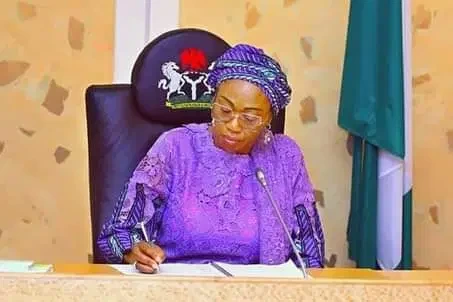
According to a report by Vanguard News on Wednesday, August 26, 2026, the Federal Government has launched the $1 billion Household Prosperity and Empowerment Social Protection Project (HOPE-SP), a social protection initiative aimed at helping vulnerable Nigerians move from temporary assistance to sustainable economic empowerment and self-reliance.
The programme was unveiled on Wednesday at the State House Banquet Hall in Abuja alongside four other initiatives intended to strengthen Nigeria’s humanitarian response and poverty reduction efforts. The additional programmes are the One-Humanitarian-One Poverty Response System (OHOPRS), Emergency Cash Transfer Programme, Federal Ministry of Humanitarian Affairs and Poverty Reduction Ministerial Blueprint, and Humanity First Magazine.
Speaking at the event, First Lady Senator Oluremi Tinubu said the initiatives were designed to improve the wellbeing of vulnerable individuals, households and communities across the country. She noted that the programmes were particularly important as the administration of President Bola Ahmed Tinubu continues to implement economic reforms aimed at strengthening the economy and promoting sustainable growth.
She explained that despite the ongoing reforms, many Nigerian families continue to experience economic difficulties and require support. According to her, HOPE-SP would improve the identification of vulnerable households, assess their specific needs and provide appropriate assistance.
The First Lady said the programme would go beyond short-term relief by combining immediate support with measures that would help beneficiaries recover, become economically empowered and eventually achieve self-reliance.
She described the One-Humanitarian-One Poverty Response System as a coordinated national platform for humanitarian emergencies, social protection and poverty reduction. The system is expected to reduce duplication among government interventions while providing unified records through which vulnerable households can be identified, assisted and monitored as they progress towards economic stability.
She added that the Emergency Cash Transfer Programme would offer quick financial support to households affected by economic shocks, while the ministerial blueprint would convert the humanitarian and poverty-reduction priorities of the Renewed Hope Agenda into measurable actions.
Senator Tinubu also described the Humanity First Magazine as an important part of the initiative because it would highlight the experiences of Nigerians whose lives have been improved through government programmes.

She commended the Minister of Humanitarian Affairs and Poverty Reduction, Dr Bernard Doro, and his team for developing the initiatives, expressing confidence that they would transform humanitarian intervention from temporary assistance into sustainable pathways to resilience, prosperity and a dignified life.
In his remarks, Doro said the initiatives represented a new national framework for humanitarian intervention and social protection, with the government moving away from reactive palliatives towards proactive empowerment.
He acknowledged that economic reforms, including the removal of fuel subsidy and the unification of the foreign exchange market, had contributed to stronger government revenue and improved investor confidence. However, he stressed that Nigerians must also be protected from economic shocks and given sustainable opportunities to escape poverty.
According to the minister, the government intends to replace reactive relief with anticipatory social protection and focus on reducing poverty rather than simply managing its effects.
Doro identified fragmentation among existing social intervention programmes as a major challenge. He explained that various government ministries, departments, agencies and different levels of government often operated separate programmes, resulting in duplication and uneven coverage.
Under the new system, the focus would shift from individual programmes to households. Vulnerable families would be identified, their needs assessed and appropriate assistance provided. They would then be monitored through a poverty graduation pathway designed to move them towards economic inclusion and self-reliance.
The minister said the system would rely on unified data, digital delivery infrastructure, improved financing arrangements and real-time poverty information. It would also encourage stronger cooperation among federal, state and local governments and development partners.
He said the One-Humanitarian-One Poverty Response System would establish a single platform for humanitarian and poverty-reduction interventions, ending the practice of different government agencies maintaining separate beneficiary registers and data centres.
Doro disclosed that existing databases would be integrated into a unified platform built around the National Social Register, which currently contains approximately 20 million households. Beneficiaries would be monitored from identification and intervention through an exit process and eventual movement into a growth register, while a digital dashboard would provide an overview of government interventions.
He also announced plans to establish a National Poverty Intelligence Lab. According to him, the effectiveness of government programmes would increasingly be assessed by the number of households protected, economically included and eventually lifted out of poverty, rather than by the quantity of materials distributed.
Minister of Budget and Economic Planning, Senator Atiku Bagudu, said successful social protection required a coordinated approach involving the federal, state and local governments as well as other stakeholders.
Bagudu stated that the administration’s goal of building a $1 trillion economy by 2030 must be matched with deliberate efforts to ensure that economic opportunities and prosperity reach people at the grassroots.
He highlighted the government’s ward development initiative covering 8,809 wards nationwide, explaining that it was designed to identify the causes of poverty and exclusion at the community level and transform the wards into centres of economic opportunity and inclusion.
The minister also said the government was increasing budgetary attention to peace, security and other areas of social protection to prevent Nigerians from falling into poverty because of domestic and international economic shocks.
He noted that global events, including the Russia-Ukraine conflict and instability in the Middle East, continue to affect households and economies, making effective social safety nets increasingly necessary.
Bagudu said Nigeria already had substantial resources and programmes dedicated to social protection and poverty reduction, including a World Bank portfolio worth about $6 billion. However, he stressed that improved coordination was necessary to ensure that the available resources produced greater results.
Borno State Governor, Professor Babagana Zulum, also praised the Federal Government for introducing the initiative. He described it as an important step towards addressing vulnerability among Nigerians.
Zulum, whose state has faced prolonged humanitarian challenges linked to insurgency, stressed that the causes of insecurity and instability, particularly poverty and social inequality, must be addressed.
He maintained that lasting peace and security would require more than immediate humanitarian assistance, noting that interventions must also tackle the underlying conditions that make individuals and communities vulnerable.
He further called for continued research into issues concerning identity and national security while congratulating the Federal Government and the Ministry of Humanitarian Affairs and Poverty Reduction on the new initiatives.
SOURCE: Oinfo2
