
For decades, Nigeria has stood as one of the world’s most resource-rich oil producers, yet its economic story has remained curiously incomplete. While crude oil has powered government revenues and positioned the country as a major player in global energy markets, the deeper promise of that resource, industrialisation, manufacturing growth, and value-added production has largely gone unrealised. In contrast, major economic corridors located at the Persian Gulf, gated by the Strait of Hormuz maritime checkpoint, have demonstrated how oil can serve not just as a commodity for export but as the foundation of vast industrial ecosystems that drive global trade. This feature written by Gideon Osaka explores that divergence. It examines how Nigeria’s refining journey fell short of building a robust petrochemical and manufacturing base and how new developments, particularly the rise of the private refineries, are beginning to challenge that legacy. At its core, the story is not just about oil but about what a nation chooses to do with it and what it risks losing when it fails to think beyond crude
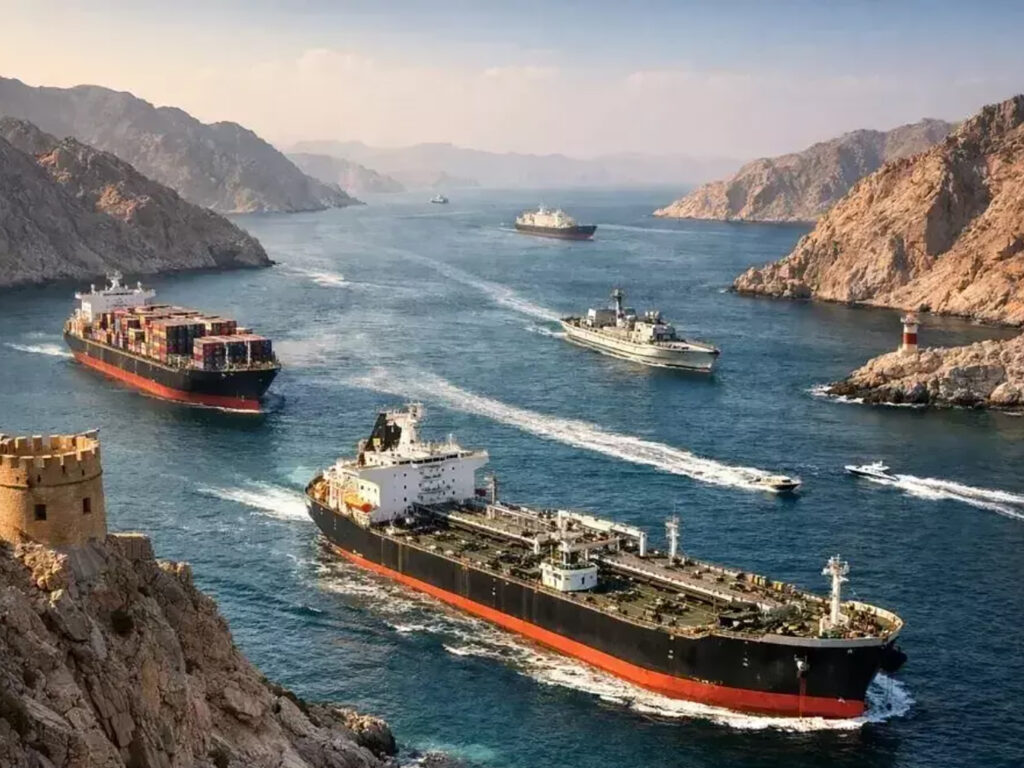
Few places in the world define the global energy system as sharply as the Strait of Hormuz. A narrow maritime corridor, it handles roughly a fifth of the world’s oil trade. Every day, millions of barrels pass through its waters, connecting producers in the Gulf region to markets across Asia, Europe, and beyond. Yet, the true significance of Hormuz is not merely the volume of oil that moves through it; it is the industrial ecosystems that have been built around that flow.
According to Britannica, the Strait of Hormuz is the only sea channel linking the oil-rich Persian Gulf (west) with the Gulf of Oman and the Arabian Sea (southeast). More than 20 per cent of global oil and liquefied natural gas exports pass through the strait, which serves as the primary route for oil and gas exported from Iran, Iraq, Kuwait, Qatar, and the United Arab Emirates (although the United Arab Emirates can divert most of its exports through its Fujairah emirate on the Gulf of Oman). The exports are geographically focused, about four-fifths go to importing countries in Asia, especially China, India, Japan, and South Korea, but the volume of the supply has a profound impact on pricing worldwide due to the low elasticity of prices for petroleum products. Along with the Strait of Malacca that connects the Indian Ocean to the Pacific Ocean, the Strait of Hormuz is one of the most vital oil chokepoints in the global economy. The strait is 35 to 60 miles (55 to 95 km) wide and separates Iran (north) from Oman’s Musandam exclave on the Arabian Peninsula (south). The United Arab Emirates is also located near the strait, about 40 to 50 miles (65 to 80 km) from the strait’s narrowest point on either side of the Musandam Peninsula.
In a recent BBC report, in 2025, about 20 million barrels of oil and oil products passed through the Strait of Hormuz per day, this is according to estimates from the US Energy Information Administration (EIA). That is nearly $600bn (£447bn) worth of energy trade per year. The oil comes not only from Iran but also from other Gulf states such as Iraq, Kuwait, Qatar, Saudi Arabia and the UAE. About 20% of global LNG is also shipped through the strait, mostly from Qatar. In 2024, it exported about 9.3 billion cubic feet per day (Bcf/d) of LNG through the strait, and the UAE exported about 0.7 Bcf/d, according to the US government. Hormuz is also a crucial route for exports of fertiliser from the Middle East, where natural gas is used heavily in the production process. About one-third of the world’s fertiliser trade normally passes through the Strait.
On one side of that corridor sit nations that long ago understood that crude oil, on its own, is only the beginning of value creation. Over time, they transformed their hydrocarbon wealth into sprawling industrial complexes, petrochemical hubs, and export-driven manufacturing economies. In those countries, oil is not just burned; it is broken down, reassembled, and converted into plastics, chemicals, fertilisers, and consumer goods that power global supply chains.
Now imagine, for a moment, a different Nigeria, one in which the aforementioned scenario had evolved along similar lines and sustained. Imagine a country where crude oil was not simply exported, where refineries did more than produce fuel, and where by-products formed the backbone of industrial growth. Imagine a Nigeria that functioned not just as a producer, but as a processing hub for West and Central Africa; its own version of ‘Hormuz’, not geographically, but economically. That Nigeria never emerged.
Instead, what exists today is a striking contrast between what could have been and what is only now beginning to take shape, driven largely by private initiative, most notably the rise of the Dangote Refinery. The planned Linear Alkyl Benzene (LAB) plant within that complex offers a powerful lens through which to examine this divergence between a past defined by wasted opportunities and a future that may yet be reclaimed.
The Hormuz Model: From Oil Transit to Industrial Power
The countries gated by the Strait of Hormuz did not begin with industrial sophistication. Like Nigeria, they started as resource-rich economies dependent on crude exports. However, over time, they made a decisive shift: instead of treating oil as a commodity to be sold, they treated it as a feedstock to be transformed. This shift manifested in three critical ways.
First, they invested heavily in refining complexity. Modern refineries in the Gulf are not simple fuel-processing plants; they are advanced conversion systems capable of extracting maximum value from every barrel. Heavy crude fractions are broken down into lighter components, while intermediate streams are redirected into chemical production.
Second, they built petrochemical integration into the core of their energy strategy. Facilities in places like Jubail and Ruwais produce not just fuels, but also ethylene, propylene, benzene, and other building blocks of modern industry. These chemicals feed into plastics, packaging, textiles, automotive components, and countless other sectors.
Third, they developed industrial clusters. Around these refining and petrochemical hubs grew entire ecosystems of manufacturing, logistics, and export infrastructure. Ports, pipelines, industrial zones, and specialised industries formed a tightly linked network, ensuring that value creation did not stop at the refinery gate.
The result is an economic model in which oil is not merely extracted; it is continuously transformed into higher-value products, creating jobs, exports, and industrial capacity.
The Global Reality: Fossil Fuels Still Power the World
Despite the growing push by Western economies toward renewable energy and decarbonization, fossil fuels remain the backbone of the global economy. Oil and gas continue to power transportation, manufacturing, aviation, shipping, and even the production of renewable energy infrastructure itself. The reality is that the world has not yet found a scalable substitute capable of fully replacing hydrocarbons in the near term. This dependence becomes even more evident during periods of geopolitical tension, particularly around critical supply routes such as the Strait of Hormuz. Whenever instability threatens this corridor, as seen in recurring tensions involving Iran, the United States, and regional actors, global oil prices respond almost immediately, often triggering sharp increases in petrol prices across markets. Such volatility underscores a fundamental truth: regardless of long-term energy transitions, control over oil supply and refining capacity still translates directly into economic and geopolitical power.
This means that Africa, which is home to a trillion barrels of crude, must take advantage and develop its oil sector to match Hormuz. Like Dr. Omar Farouk Ibrahim once said, “If we want Africa to move forward, we need to put on a new thinking cap. For so long, our intellectuals and leaders have become just takers of prescriptions made outside our continent. The earlier we begin to scrutinise problems and solutions that we are given, the better for our continent… “
As Africa stands at the crossroads of global energy transitions, the call by Dr. Farouk serves as a clarion call for self-determination and regional empowerment in shaping the continent’s energy future. He emphasises the imperative for African nations to critically evaluate external energy prescriptions, asserting that Africa must chart its own course based on its unique needs and circumstances. Stressing the need to prioritise the empowerment of African populations with access to energy, to signal a transformative shift towards sustainable development and economic growth.
The call by Dr. Farouk further highlights the economic implications of energy decisions, arguing that empowering African populations with access to energy could significantly boost productivity and government revenue. “The earlier we empower our people to have access to energy, the better for our development. We have been made to believe that empowering our people to have energy is not an economic argument; I don’t believe that. I would rather empower my people to have energy, not just to have light, but to use that energy so that their production and their economic productivity will increase to the point that the government can even earn more taxation than from exporting oil”.
Central to his message was the assertion that Africa must develop its own energy solutions tailored to its unique needs and circumstances. While expressing scepticism about the feasibility of renewables delivering on their promises within the projected timelines, Dr. Farouk warned of potential consequences for Africa if it relies solely on external directives without adequate infrastructure or development.
“What we are saying is this: when we say that we don’t agree with certain positions that others say and prescribe to us, which our leaders have come to accept and because these institutions have built within our countries forces that they pay to propagate those positions, we are seen as being unrealistic. Our fear is that if we allow ourselves to be bamboozled into accepting all of these things, and abandoning what we have in the expectation of what we will not have, and we are sure that renewables will not materialise by 2050, we are going to be the biggest victims in the world. This is because when there is a shortage of anything (this is simple economics), those with the resources to buy will take everything, and that is exactly what is happening. If we fail to produce our energy and renewables fail to deliver, the little that we produce, we are going to be compelled to export it to Europe and America, and we will continue the way we are or even worse. This is because they have the purchasing power; we don’t have it. It is exactly what is happening today: we produce and export 75% of the oil that we produce in Africa to outside Africa. And 45% of the gas that we produce also goes outside of Africa.”
According to Dr. Farouk, “For so long, we have been criticising what the world is telling Africa to do, and we are also criticising our leaders for accepting this counsel. I recall that… the IEA came up with a report condemning fossil fuels, asking the world not to invest in them because the renewables are going to deliver by 2030, 2040 to 2050s. We wrote to condemn what the IEA Executive Director said. We believe he was wrong. In the Wall Street Journal, I saw a story that the International Energy Agency is being criticised for misleading the world about the energy transition. In the Journal, it was stated that the IEA once provided solid information, but today, its report can no longer be trusted; it has succumbed to politicisation. IEA’s influential demand forecast now reflects wishful thinking.”
Dr. Omar Farouk Ibrahim has issued a rallying call for Africa to chart its own course in the face of global energy transitions. He emphasised the need for critical evaluation of external prescriptions and underscored the importance of Africa taking control of its energy destiny.
Dr. Farouk highlighted key concerns regarding the global shift from fossil fuels to renewable energy sources. He raised questions about the origins of this transition, the timing of awareness regarding fossil fuel dangers, and the measures being taken by developed nations to ensure energy security for their citizens. He urged African nations not to blindly accept these recommendations but to scrutinise them thoroughly to safeguard their interests.
Nigeria’s Divergence: The Refining That Stopped at Fuel
Nigeria, on the other hand, despite having similar resource advantages, took a different path. Decades ago, the country built refineries in Port Harcourt, Warri, and Kaduna. These facilities were intended to meet domestic fuel needs, and in that sense, they mirrored early-stage refining systems in other oil-producing nations.
However, unlike their counterparts in the Gulf, Nigeria’s refineries never evolved beyond this initial stage. They remained focused on producing petrol, diesel, kerosene, and fuel oil, with little attention to the broader spectrum of products that crude oil can yield.
This limitation had far-reaching consequences. While Gulf countries were building petrochemical industries, Nigeria was importing the very products that its crude could have produced. While others were creating industrial clusters, Nigeria’s refining sector remained isolated, disconnected from manufacturing and export systems.
Perhaps most tellingly, Nigerians, especially the younger generation, rarely hear about refining by-products. There were no large-scale discussions about chemical derivatives, no thriving industries built on refinery outputs beyond fuels, and no visible link between crude oil and everyday manufactured goods. In effect, the country operated a truncated value chain, one that began with extraction and ended prematurely with basic refining.
The Cost of Stagnation
The failure to evolve had economic, industrial, and strategic implications.
Economically, Nigeria experienced value leakage on a massive scale. Crude oil was exported at a relatively low value, while refined products and petrochemicals were imported at a higher cost. This imbalance placed continuous pressure on foreign exchange reserves and limited the country’s ability to build a resilient economy.
Industrially, the absence of petrochemical integration meant that key sectors, such as plastics, textiles, and detergents, remained underdeveloped or dependent on imports. Local manufacturers faced higher costs and limited access to inputs, constraining growth and competitiveness.
Strategically, Nigeria missed the opportunity to position itself as a regional hub. Given its size and resource base, the country could have served as a processing and distribution centre for West and Central Africa, much like the Gulf states’ linked economies serve global markets. Instead, it became a net importer of refined products for decades.
At the heart of this stagnation were structural issues within the industry, including governance challenges, underinvestment, and a policy framework that prioritised short-term consumption over long-term industrialisation.
Dangote’s Intervention: A Glimpse of the Road Not Taken
The emergence of the Dangote Refinery changes the narrative in a fundamental way. Unlike traditional refineries, it is designed as an integrated complex, capable of producing both fuels and petrochemical feedstocks.
The planned LAB plant is particularly significant in this context. Linear Alkyl Benzene is a key input in detergent production, a product that touches millions of households daily. By producing LAB locally at scale, the refinery will not only reduce import dependence but also create a direct link between crude oil and consumer goods.
This is precisely the kind of integration that Nigeria lacked for decades. It represents a shift from viewing refining as an endpoint to seeing it as a starting point for industrial activity.
More broadly, the Dangote model aligns closely with the Gulf States model. It emphasizes:
Deep conversion of crude oil Integration with petrochemical production Creation of industrial ecosystems. In doing so, it offers a glimpse of what Nigeria’s oil sector might have become if it had evolved differently.
Previously, there was Eleme Petrochemicals Company Limited (EPCL) in Port Harcourt, Rivers State, a petrochemicals complex originally fully owned by the Federal Government of Nigeria and commissioned in 1996. Although built to international standards, situated to utilise Nigeria’s abundant natural gas supplies, and designed to produce products with consistently high demand, EPCL was never managed effectively, never operated to its full potential, and was a considerable loss-maker and drain on the State treasury.
Pre-privatisation documents indicate that EPCL had an untenable debt burden, needed capital investment, and would not be profitable for its buyer for several years.
In 2006, EPCL was privatised by the sale of 75% of its shares to a core investor through a competitive bidding process. Little international interest was attracted. The company was sold to Indorama Group without liabilities, which were retained by the FGN. The company was handed over on October 26, 2006
Nigeria as a Hypothetical Gulf States Hub
If Nigeria had followed the Gulf States model, its energy landscape today would look radically different.
Its refineries would operate as multi-product complexes, producing not only fuels but also a wide range of chemicals and industrial inputs. Petrochemical plants would be integrated into these facilities, supplying raw materials for domestic manufacturing and exports.
More industrial zones like Indorama would have developed around refining hubs, attracting investment in sectors such as plastics, textiles, packaging, and consumer goods. Ports and logistics infrastructure would support large-scale exports, positioning Nigeria as a key supplier to regional and global markets.
Most importantly, the narrative around oil would have shifted. Instead of focusing solely on crude production and fuel prices, public discourse would include discussions about chemical outputs, industrial capacity, and value-added exports.
In essence, Nigeria would function not just as an oil producer but as an industrial powerhouse anchored by its hydrocarbon resources.
The Reckoning for Nigeria
The contrast between this hypothetical scenario and reality raises difficult questions for Nigeria. After decades of refining, why did such a transformation not occur?
Part of the answer lies in institutional structure. As a state-owned entity, Nigerian energy regulatory agencies operated within a framework shaped by political considerations, bureaucratic processes, and limited accountability. These factors often hinder long-term planning and investment.
Another factor was the absence of a coherent industrial policy. While other countries aligned their energy strategies with broader economic goals, Nigeria’s approach remained fragmented, with little coordination between refining and manufacturing.
There was also a failure to adapt. As global refining evolved, Nigeria’s system remained largely static, unable to incorporate new technologies or respond to changing market dynamics.
The result was a lost opportunity, one that is only now being partially addressed through private-sector initiatives.
A Path Forward: Learning from Gulf States, Building at Home
The emergence of Dangote’s integrated model offers a pathway for reform. For Nigeria to realise its potential, several steps are essential.
First, there must be a redefinition of refining. It must be seen not as a utility, but as a strategic industry capable of driving economic transformation.
Second, investment in modern, high-complexity facilities is crucial. Existing refineries must be genuinely upgraded or replaced with systems capable of deep conversion and petrochemical integration.
Third, the country must develop industrial linkages. Refining outputs should feed directly into manufacturing sectors, creating a virtuous cycle of production and value addition.
Fourth, governance reforms within the Nigerian energy sector are necessary to ensure efficiency, transparency, and accountability.
Finally, there must be a long-term vision, one that aligns energy policy with industrial development and positions Nigeria as a regional hub.
Overall, the story of Nigeria’s oil sector is often told in terms of production volumes and revenue figures. Yet, the more important story is about transformation or the lack of it. For decades, the country extracted wealth from the ground but failed to build the industries that could sustain long-term growth.
The comparison with the Strait of Hormuz is not about geography; it is about strategy. It is about what happens when oil is treated as a starting point rather than an endpoint.
With the rise of the Dangote Refinery and projects like the LAB plant to complement Indorama Eleme Petrochemicals Complex, Nigeria will again begin to explore that alternative path. The question is whether this represents a broader shift or merely an isolated example of what could have been achieved much earlier.
In the end, the choice is clear. Nigeria can continue to operate within the limits of its past, or it can embrace a new model, one that turns crude oil into the foundation of industrial power. The future of the energy sector, and indeed its economy, will depend on that decision.
