
Spot gold fell 0.1% to $3 363.57 an ounce
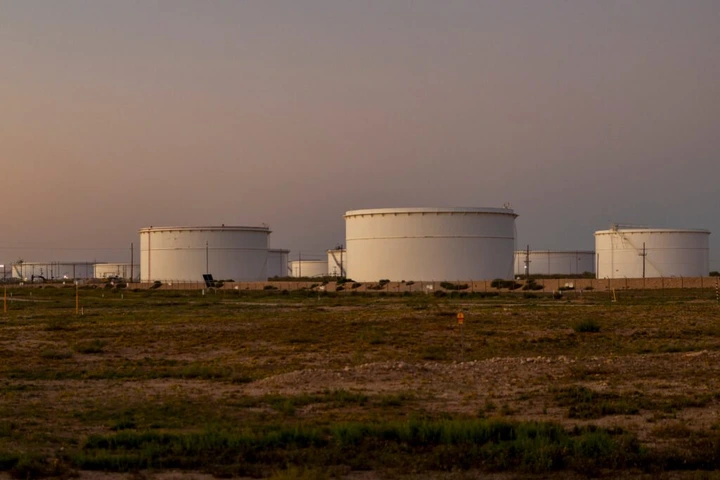
Image: Anthony Prieto/Bloomberg
The dollar and oil pared an early advance, as traders awaited Tehran’s response after Washington struck Iran’s nuclear sites over the weekend.

A Bloomberg gauge of the greenback climbed 0.2%, while global crude benchmark Brent rose almost 2% after surging as much as 5.7%. Contracts for the S&P 500 declined around 0.3% and a gauge of Asian equities fell to the lowest since early June. Treasury yields ticked higher.
Oil remained the primary focus as any disruption to traffic through the Strait of Hormuz, a major artery for global crude and natural gas, has raised the specter of a spike in energy prices. While Iran’s Foreign Minister Abbas Araghchi said the country reserves all options to respond, there haven’t yet been any signs of actual disruption to physical oil flows.
“This kind of uncertainty is quickly becoming the new normal for markets, so I expect to see a relative sense of calm unless we see tensions keep rising, which, to be clear, it has the potential to do,” said Josh Gilbert, a market analyst at eToro in Sydney. “Even without an immediate fallout, the mix of oil volatility and renewed uncertainty is likely to be enough to keep risk appetite subdued.”
Market reaction had been generally muted since Israel’s initial assault this month. Even after falling for the past two weeks, the S&P 500 is only about 3% below its all-time high from February. The dollar has climbed just over 1% since hitting a three-year low earlier this month.
Whether this will hold depends a lot on Iran’s next move, according to some market watchers.
“It’s very highly likely that Iran will strike back against the United States in some way,” said Ben Zala, senior lecturer in international relations at Monash University in Melbourne. “The market in this regard will be very, very reactive to military events in the region — across stocks, bonds, currencies — because we just don’t know the exact way that this is going to play out.”
If oil flows through the Strait of Hormuz were to drop by half for a month, and remained 10% lower for another 11, Brent would spike briefly to as much as $110 a barrel, according to Goldman Sachs Group Inc.
Iran has vowed to impose “everlasting consequences” for the bombing. Meanwhile, Israel resumed its assaults, targeting military sites in Tehran and western Iran.
“If a cycle of retaliation continues, increased US fiscal spending could lead to a rise in Treasury yields and US stock prices,” Ataru Okumura, a senior interest-rate strategist at SMBC Nikko Securities Inc., wrote in a note. In the conflict in Iraq in 2003 and the Gulf War in 1991, “US stocks rallied as the stimulus effect of massive war spending became apparent or was expected to become apparent.”
The downside may be limited because some market participants have been preparing for a worsening conflict. The MSCI All Country World Index has pulled back 1.5% since Israel attacked Iran on June 13. Fund managers have reduced their stock holdings, shares are no longer overbought and hedging demand has increased, meaning a deep selloff is less likely at these levels.
Meanwhile, credit spreads on Asian high-grade dollar bonds widened the most in five weeks. On the equities front, shipping stocks such as Ningbo Marine and Nanjing Tanker advanced on speculation that tanker freight rates may rise following the US airstrikes. Asian defense stocks rose while airline shares declined on the back of higher oil prices.
Shares of Taiwan Semiconductor Manufacturing Co. retreated after the Wall Street Journal reported a US Commerce Department official has told top chip companies he wants to revoke waivers they have used to access American technology in China. Samsung Electronics Co. and SK Hynix Inc. also fell.
Elsewhere, Federal Reserve Bank of San Francisco President Mary Daly on Sunday said she sees the central bank’s monetary policy stance as “in a good place” currently, with risks to its US employment and price stability mandates as roughly equal. Daly said she sees the central bank cutting rates in the fall, later than Governor Christopher Waller who said Friday he sees a move as soon as July.
Traders will be parsing economic activity data in Europe and the US later Monday to gauge whether the US trade war has crimped factory output ahead of the July 9 reciprocal tariff deadline. European Central Bank President Christine Lagarde is also due to speak.
Some of the main moves in markets:
Stocks
- S&P 500 futures fell 0.3% as of 12:05 p.m. Tokyo time
- Nikkei 225 futures (OSE) fell 0.4%
- Japan’s Topix fell 0.6%
- Australia’s S&P/ASX 200 fell 0.6%
- Hong Kong’s Hang Seng fell 0.2%
- The Shanghai Composite rose 0.1%
- Euro Stoxx 50 futures fell 0.5%
Currencies
- The Bloomberg Dollar Spot Index rose 0.2%
- The euro fell 0.2% to $1.1501
- The Japanese yen fell 0.3% to 146.60 per dollar
- The offshore yuan fell 0.1% to 7.1884 per dollar
- The Australian dollar fell 0.6% to $0.6414
- The British pound fell 0.2% to $1.3429
Cryptocurrencies
- Bitcoin rose 1.8% to $101,307.25
- Ether rose 2.5% to $2,242.18
Bonds
- The yield on 10-year Treasuries advanced two basis points to 4.39%
- Japan’s 10-year yield advanced three basis points to 1.420%
- Australia’s 10-year yield advanced four basis points to 4.22%
Commodities
- West Texas Intermediate crude rose 1.8% to $75.19 a barrel
- Spot gold fell 0.1% to $3 363.57 an ounce
