

…Beneath the dry winds, millions of lives are at risk as farmland turns to dust
By Ese Ufuoma
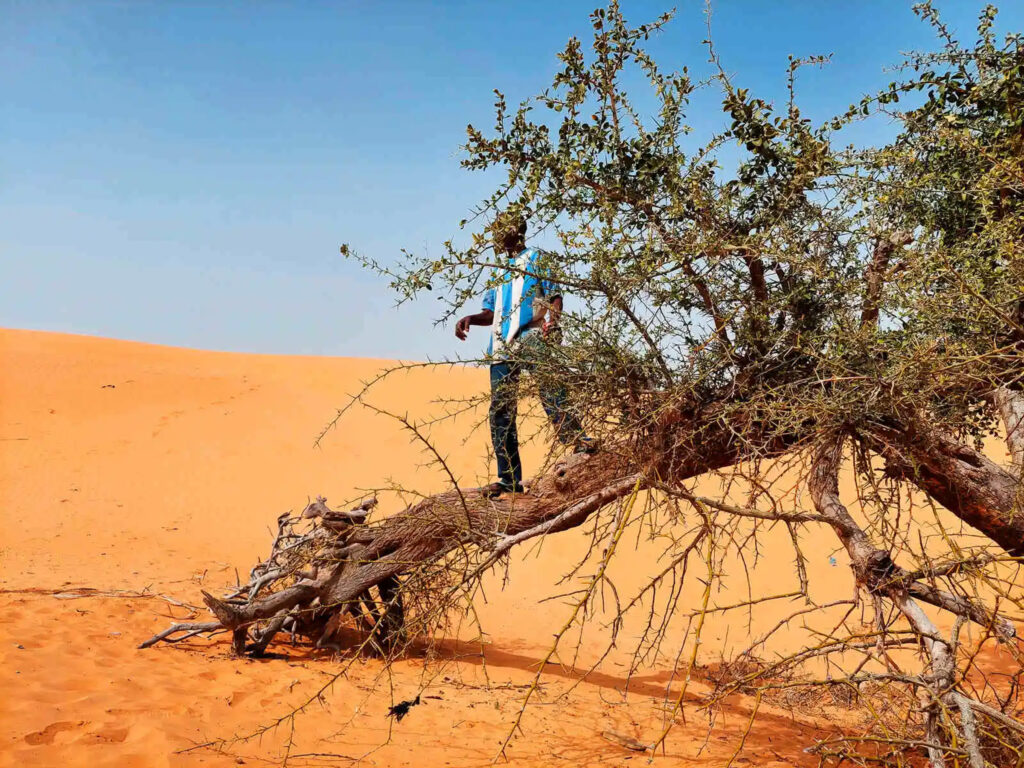
Driving through northern Nigeria today, you can’t ignore how the land seems to be slipping away beneath your tyres. In states like Sokoto, Bauchi, and Yobe, once-fertile farmland has receded, now replaced by encroaching sand that stubbornly swallows the landscape that once supported families and livestock.
The Ministry of Environment recently revealed that between 50% and 75% of the land in northern states, including Bauchi, Borno, Gombe, Jigawa, Kano, Katsina, Kebbi, Sokoto, Yobe, and Zamfara, is already affected by desertification. These areas, which are home to nearly 27 million Nigerians and are vital for cattle grazing and crop farming, are at the forefront of an environmental crisis.
This isn’t just a statistic; it’s a lived reality. With water sources diminishing and soil losing its fertility, farmers urgently need relief. A United Nations report cited by BusinessDay depicts a grim situation of over 2 million hectares of fertile land disappearing globally each year due to drought and land degradation, along with 24 billion tonnes of topsoil. Nigeria’s leadership recognises the danger, noting that every dollar invested in land restoration can yield up to thirty dollars in return.
Nigeria’s response is centred on the Great Green Wall initiative, a large transcontinental effort aimed at halting desert encroachment. Its national agency, The National Agency for the Great Green Wall (NAGGW), has planted 21 million trees across eleven frontline states and distributed 44 million seedlings to farmers and communities. Beyond planting, the programme has implemented solar-powered boreholes, mini dams for rainwater harvesting, and starter kits for beekeeping, carpentry, and solar-powered irrigation to diversify livelihoods.
Today, the NAGGW is strengthening these efforts. In August, Yobe State launched a large-scale campaign to plant at least five million improved seedlings, including date palms, each capable of producing up to 100 kg of fruit annually, providing both ecological restoration and an economic boost to struggling communities.
However, the project is anything but straightforward. Security threats, from banditry to kidnappings, are turning parts of the Green Wall into danger zones. Volunteers and forestry workers, who once planted with hope, now face the threat of violence in areas where desertification and conflict meet.
Nevertheless, solutions are also emerging from within communities. Youth and women are being mobilised as agents of change, trained as “Green Youth Champions,” and empowered to restore degraded lands through agroforestry, sustainable farming, rainwater harvesting, and eco-entrepreneurship.
Nigeria is recognising that the fight against desertification is more than just environmental; it’s about maintaining food supplies, protecting livelihoods, and safeguarding peace. It will require equipment and technical expertise, but more importantly, it needs community commitment, the restoration of degraded ecosystems, and policies that integrate