By Anscella Obike
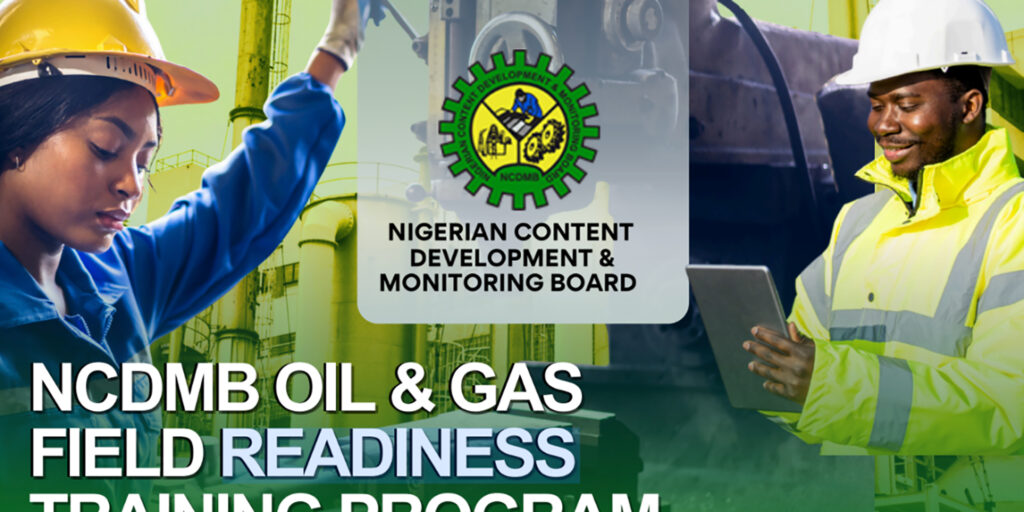
As Nigeria experiences a resurgence of billion-dollar oil and gas investments, the Nigerian Content Development and Monitoring Board (NCDMB) has announced a major national initiative to equip over 10,000 young Nigerians with high-demand technical and professional skills for the energy industry.
Unveiling the NCDMB Oil and Gas Field Readiness Training Programme in Yenagoa, Bayelsa State, the Executive Secretary of the Board, Engr. Felix Omatsola Ogbe, said the scheme was designed to prepare the next generation of local professionals for the raft of new oil and gas projects recently sanctioned by international oil companies (IOCs) and indigenous operators.
According to Ogbe, the programme is a direct response to Nigeria’s growing investment momentum, with a surge in Final Investment Decisions (FIDs) marking the strongest show of investor confidence in nearly a decade. “We have seen a resurgence of big-ticket projects in our upstream sector: Shell’s $2 billion HI Field Gas Project, TotalEnergies’ $550 million UBETA Gas Project, and the $5 billion Bonga North Deepwater project, among others. These developments signal that the next decade will be a defining period for Nigeria’s energy workforce,” he said.
Bridging the Skills Gap for a New Era
The training program, Ogbe explained, was crafted after a detailed analysis of expatriate quota applications and consultations with leading industry associations such as the Petroleum Technology Association of Nigeria (PETAN), Oil Producers Trade Section (OPTS), and Petroleum Contractors Trade Section (PCTS).
Through these engagements, the NCDMB identified 10 top-priority skill areas where Nigeria currently faces significant workforce shortages. These include:
- Sub-sea Engineering – covering wellheads, flowlines, umbilicals, and subsea trees.
- Underwater Welding – a critical capability for offshore maintenance and repairs.
- Control and Automation Engineering – including rig operations, cementing, and well controls.
- Helicopter Piloting – to meet offshore logistics and mobility demands.
- Seamanship and Marine Operations – including vessel mechanics and electricians.
- Production and Maintenance Engineering – such as control room operations and maintenance support.
- Quality Assurance and Quality Control (QA/QC) – incorporating Non-Destructive Testing (NDT) Levels 1, 2, and 3.
- Geoscience and Petroleum Engineering – with focus on seismic, geophysics, and wellsite geology.
- Digitisation and Digitalisation – covering Artificial Intelligence (AI), Internet of Things (IoT), Big Data, Cloud Computing, and drones.
- HSE and Soft Skills Development – for holistic competence and safety culture.
The initiative aligns with Section 10(1b) of the Nigerian Oil and Gas Industry Content Development (NOGICD) Act, 2010, which mandates that Nigerians be given first consideration for training and employment in industry work programmes.
Empowering the Next Generation
The NCDMB’s Director of Capacity Building, Engr. Bamidele Abayomi, explained that the Field Readiness Program will be implemented over a two-to-three-year cycle, with periodic reassessment to ensure alignment with emerging industry needs.

“Each training stream will run for a minimum of 12 months, combining classroom instruction, laboratory and workshop practicals, industry certifications, and at least six months of on-the-job training (OJT) with leading service companies,” Abayomi noted.
He disclosed that at least three specialised service companies will partner with the NCDMB in each skill area, while training on Health, Safety, and Environment (HSE) as well as soft skills will be coordinated by OGTAN-registered training providers and certified anchor trainers.
Participants who successfully complete the programme will be certified “field-ready” and included in the NCDMB’s National Skills Database, a reference system circulated among operating and service companies to fulfil local content employment requirements.
In addition to technical training, participants will receive pre-mobilisation medicals, monthly stipends, personal protective equipment (PPEs), and insurance coverage. These provisions are designed to ensure participants focus fully on developing professional competence without financial or logistical constraints.
Eligibility and Application Guidelines
The programme is open to Nigerians below 35 years of age with qualifications ranging from OND, HND, to B.Sc. in engineering and science-related fields. Disciplines eligible include Petroleum, Mechanical, Chemical, Electrical, Civil, Gas, Welding, and Metallurgy, as well as Geology, Geophysics, and Computer Sciences/Engineering.
Interested applicants are to register via the NOGIC Joint Qualification System portal — nogicjqs.gov.ng/accounts/login — and can select up to three preferred skill areas. Applicants with existing profiles must update their records and academic credentials before completing registration for the Field Readiness Program.
Driving President Tinubu’s Renewed Hope Agenda
The NCDMB’s new HCD programme comes at a pivotal moment in Nigeria’s oil and gas industry. The October 2025 FID on Shell’s $2 billion HI Field Gas Project, in partnership with Sunlink Energies and Resources Limited, represents the latest in a wave of major upstream investments catalysed by the Presidential Directives (PDs) issued by President Bola Ahmed Tinubu in March 2024.
These directives, focused on expediting contract approvals, addressing fiscal bottlenecks, and enhancing local content participation, have led to over $8 billion in new upstream FIDs within 18 months. According to industry analysts, these reforms and NCDMB’s fast-tracked contracting guidelines are pivotal to achieving Nigeria’s $1 trillion economy vision under the Renewed Hope Agenda.
Ogbe emphasised that the Board’s human capital drive complements this vision:
“Investments without skilled Nigerians to execute them defeat the essence of local content. Our goal is to ensure that every major project approved in Nigeria translates into meaningful opportunities for our people, not just in numbers, but in competence, professionalism, and global competitiveness.”
Positioning Nigeria for Global Relevance
The oil and gas industry remains a cornerstone of Nigeria’s economy, accounting for the majority of foreign exchange earnings and a significant share of GDP. However, the sector’s competitiveness now hinges on digital transformation, specialised technical expertise, and sustainable operations.
By launching the Oil and Gas Field Readiness Program, NCDMB is addressing both short-term manpower needs and long-term structural challenges, from skills mismatch to expatriate dependency.
Observers note that the programme represents one of the most ambitious human capital interventions in the history of Nigeria’s oil and gas sector, a decisive step toward nurturing a globally competitive, future-ready workforce capable of driving innovation and sustaining local participation across the value chain.
As Nigeria’s energy sector enters a new growth phase, the NCDMB’s initiative reaffirms the nation’s commitment to transforming its youth potential into productive capacity. The Board’s proactive strategy, integrating policy, industry collaboration, and youth development, stands as a model for how resource-rich nations can use local content to create jobs, reduce capital flight, and build sustainable prosperity.
With over 10,000 Nigerians set to benefit from the programme, the NCDMB’s Field Readiness Training is not just a skills development exercise; it is a nation-building blueprint for the energy future.
