

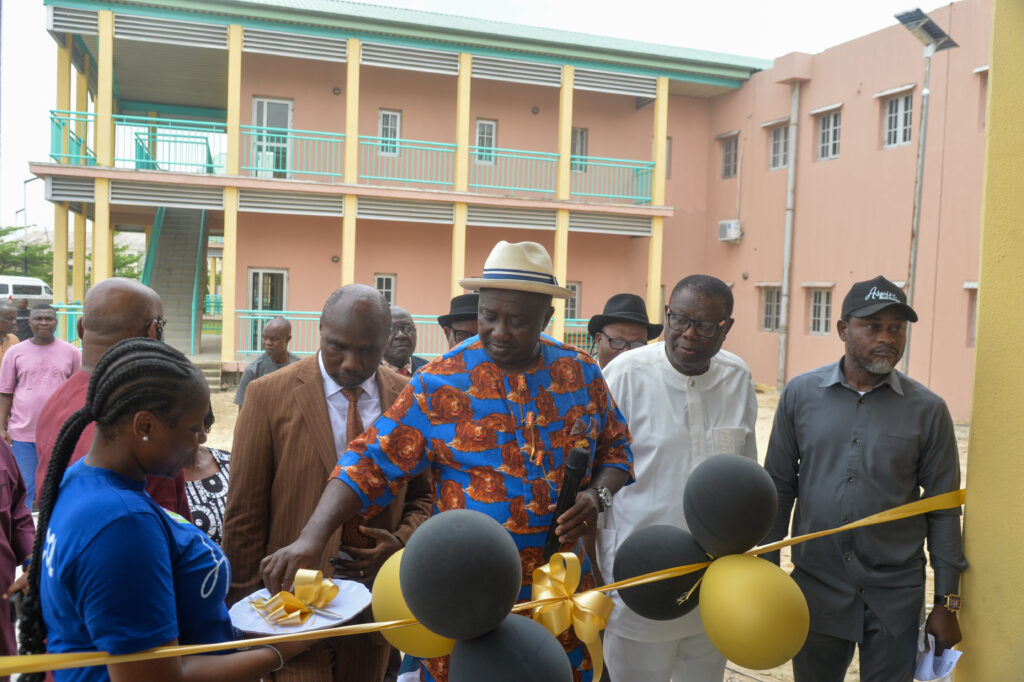
A state-of-the-art Clinical Skills and Simulation Laboratory, fully equipped by the Nigerian Content Development and Monitoring Board (NCDMB), was on Friday commissioned at the Bayelsa Medical University (BMU), Yenagoa, with the goal of positioning the institution to align with global best practices in medical education, and “strengthening local capacity in Bayelsa State and Nigeria at large.”
According to a statement by Obinna Ezeobi, PhD, who is the General Manager, Corporate Communications Division of the NCDMB, the equipment provided include high-fidelity adult and pediatric patient simulators, laparoscopic training systems, obstetric trainers, advanced life support mannequins, consultation cubicles, and audio-visual learning systems, all of which the university authorities claimed would enable students to “learn, make mistakes, and perfect their life-saving skills in a zero-risk environment before they ever touch a human patient.”

Speaking at the commissioning ceremony at the Clinical Skills Acquisition Centre, BMU Main Campus, the Executive Secretary of the NCDMB, Engr. Felix Omatsola Ogbe, said that capacity building is “not just about oil and gas; it is about ecosystems,” and that the industry does not operate in isolation. He listed health care, education, engineering, and logistics, among others, as sectors with linkage to the oil and gas industry, the statement added.
He noted that “Simulation-based learning is now the global standard in medical education,” and that it allows students to acquire hands-on clinical skills, improves decision-making, and builds confidence in a controlled safe environment before engaging the blue patient.
Represented by Mr. Ene Ette, Acting Director, Planning, Research and Statistics (PRS) of the Board, the Executive Secretary commended the Management of BMU and partner organisations for their collaboration, professionalism, and shared vision, pointing out that the upgraded laboratory is a strategic investment in human capacity and capital development and a practical demonstration of how policy can translate into measurable impact.
In his welcome address, the Vice Chancellor of the institution, Professor Dimie Ogoina, noted that the event was not just the commissioning of a building or unveiling of medical equipment, it was about “securing the future of healthcare in Bayelsa State, the Niger Delta, and Nigeria at large.” He said words could not adequately express his profound gratitude to the Management of the NCDMB.
Prof. Ogoina recalled that when he assumed office as Vice Chancellor in 2025, he shared his vision, encapsulated in what he termed A.S.P.I.R.E. Agenda, to transform Bayelsa Medical University into a globally recognised leader in medical education, research, and innovation, driven by technology and excellence. “Today,” he remarked, “as we look at this world-class facility, we are seeing the ASPIRE Agenda come to life.”
To the Executive Secretary and the entire Management of the NCDMB, he declared: “You have provided us with the very best – from advanced patient simulators and CPR mannequins to essential surgical and diagnostic kits,” noting that by equipping the lab to such a standard, the Board was “directly contributing to the reduction of medical errors, the improvement of patient safety, and the development of indigenous healthcare professionals who will serve our communities and our industries.”
“We are not just training doctors for today, we are nurturing digital-age physicians capable of competing on the global stage,” he emphasised.
Prof. Ogoina also appreciated the Bayelsa State Governor, Senator Douye Diri, and the Commissioners for Health and Education, for the unwavering support and for creating an enabling environment that allows partnerships like the one with NCDMB and its partner organisations to thrive.
In a similar vein, the Provost of the College of Medicine, Bayelsa Medical University, Professor Philip Eyimina, expressed profound gratitude to the NCDMB for its foresight and generosity in equipping the University Clinical Skills and Simulation Laboratory, and to the Bayelsa State Government for continued commitment to strengthening healthcare and education in the State.
He pointed out that the newly upgraded laboratory played a significant role in the institution’s recent accreditation verification exercise. According to him, “The presence of a functional, well-equipped Clinical Skills Laboratory strongly affirmed our readiness to deliver high-quality medical education in line with national standards.”
According to him, “In this laboratory, our students will learn essential competencies – history taking, physical examination, suturing, intravenous access, cardiopulmonary resuscitation, obstetric skills, and emergency response – while developing critical thinking, teamwork, and communication skills.”
In a special address, the State Governor, Senator Douye Diri, who is the Visitor to the University, lauded the NCDMB for providing facilities which he described as remarkable. He recalled the aspiration of the Vice Chancellor to make BMU “a leading university in medicine,” noting that “What the NCDMB has done is clearly a demonstration of going with that vision to market this university to the entire world.”
Represented by the State Commissioner for Education, Dr. Gentle Emelah, the Governor declared that the institution has the firm support of the State Government as it strives for high academic standards and global reckoning.
In a goodwill message, the Pro-chancellor of the University, Professor Tarilah Tebepah, said while the Governing Council was considering the vision of BMU becoming globally known as a leader in medical education, producing very sound innovative healthcare professionals, it never lost sight of the fact that a lot of technology, equipment and funding would be required.
He thanked the NCDMB profusely, while pleading that it should continue to identify with the institution as it grapples with resource-related challenges.
The event was concluded with a tour of key units of the state-of-the-art Clinical Skills and Simulation Laboratory, which include a Virtual Reality Station, Paediatric and Airway Management Stations, EGG and Patient Monitoring Station, IV Fluids Administration and Cannulation Station, and a Demonstration Hall.
