How Nigeria’s biggest refinery is redrawing the downstream oil map
By William Emmanuel Ukpoju
A refinery flexes its muscles
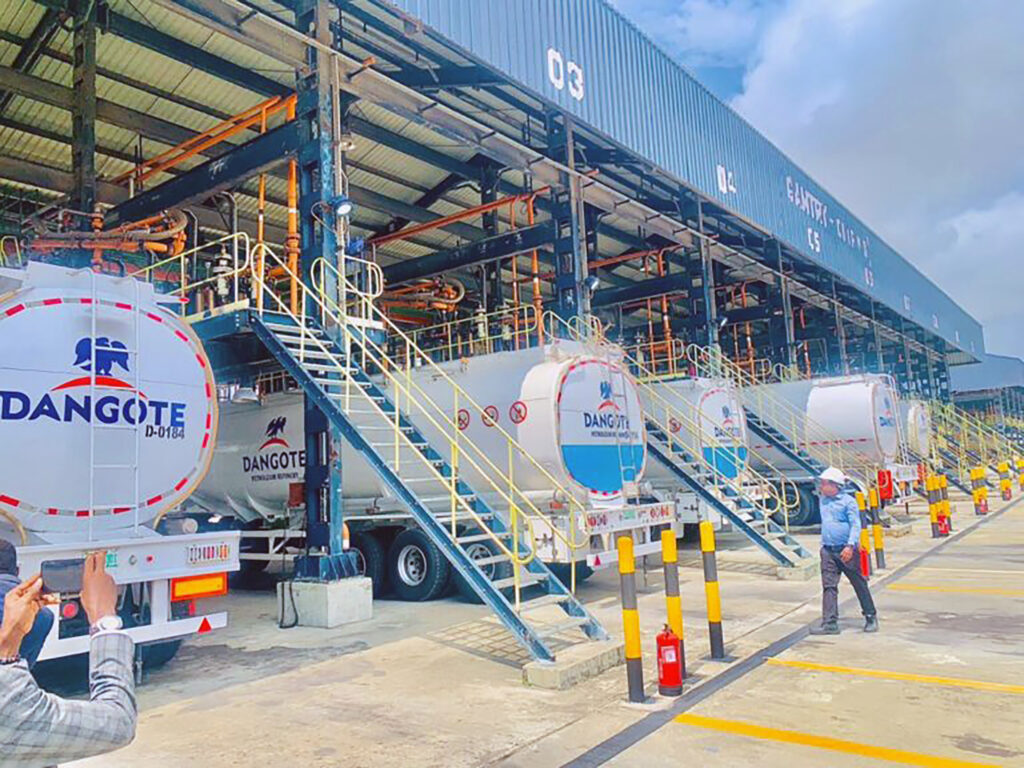
When Aliko Dangote’s $20bn refinery finally wheezed into life, many Nigerians treated it like a mirage. For years, the promise of local refining was dangled before a weary public only to vanish in the heat of subsidy disputes, import dependence, and NNPC’s faltering efforts. Yet in mid-2025, Dangote Industries unveiled a gambit that may prove more transformative than the refinery itself: direct distribution of petrol and diesel, nationwide, with “free” delivery.
From August 2025, the refinery’s fleet of 4,000 compressed-natural-gas (CNG) trucks began delivering fuel directly to filling stations, airlines, manufacturers and telcos. No middlemen. No add-on haulage costs. For a country where transport margins and graft often add more to the pump price than international oil markets, this is no small tweak. It is an attempt to seize the weakest link in Nigeria’s fuel chain and weld it into something resembling efficiency.
Vertical integration, Nigerian-style
Economists have a name for this manoeuvre: vertical integration. By owning both the refinery and the distribution network, Dangote aims to control not just supply but the path to the pump.
Professor Wumi Iledare, a petroleum economist, frames it as an “experiment in vertical integration that could either enhance efficiency and reduce costs for consumers or concentrate market power in ways that limit competition.” The difference between triumph and folly, he warns, lies in outcomes: “Lower pump prices, not monopoly power, should be the outcome.”
The long shadow of failure
To understand the boldness of the move, one must recall the decades of dysfunction it seeks to upend. Nigeria, Africa’s largest oil producer, has spent much of its post-independence history exporting crude only to import refined products at a premium. State-owned refineries in Port Harcourt, Warri and Kaduna operated in fits and starts, consuming subsidies while producing little.
By the early 2000s, subsidies on imported fuel had swollen into one of the federal budget’s largest line items, feeding smuggling and corruption. Distribution, too, became a rentier’s paradise. Marketers padded costs, depots collected fees, and truckers extracted rents from scarcity. For the ordinary motorist, the experience was grimly consistent: endless queues, sudden price hikes, and a national obsession with “black market” petrol.
Dangote’s direct delivery is, in effect, an answer to decades of bureaucratic and logistical failure. If the state could not fix distribution, a private behemoth would.
The economics of free trucks
For consumers, the effect was swift. In Lagos, petrol slipped to N841 per litre; in Abuja, slightly higher at N851. The difference reflected distance, but the broader message was clear: when the refinery absorbs haulage costs centrally, regional disparities shrink.
Dangote boasts that the new system will save Nigerians N1.7trn annually, roughly 1% of GDP, and benefit 42m small businesses. That sum dwarfs the federal health budget. Whether the calculation holds up to scrutiny is another matter, but even partial accuracy implies serious relief.
The “free” logistics, of course, are not charity. The capital cost of trucks, booster stations and drivers must be recouped, if not today then in tomorrow’s pump prices. Yet centralising these costs within one vast fleet may still prove cheaper than Nigeria’s fragmented trucking bazaar, with its diesel-burning lorries, shakedowns at checkpoints, and inconsistent scheduling.
Ripple effects on business
The beneficiaries extend beyond motorists. For Nigeria’s 42 million micro-, small- and medium-sized enterprises, everything from tricycle operators to bakeries, fuel is not a side expense but the heartbeat of survival. Generators gulp petrol during blackouts. Haulage eats margins. Volatility strangles planning.
If Dangote’s deliveries prove consistent, MSMEs stand to gain lower costs and more predictable cash flows. Analysts expect that every percentage point shaved off inflation translates into thousands of businesses staying afloat. The company claims the scheme will create 15,000 jobs directly in logistics and station operations.
Professor Iledare sees promise here. Cutting out middlemen and reducing logistics costs could stabilise supply. But, he cautions, “efficiency must serve the people, not just the powerful.”
The losers in the chain
Yet every efficiency slays someone’s inefficiency. The Natural Oil and Gas Suppliers Association (NOGASA) warns of thousands of jobs lost among independent hauliers and depot workers. The Petroleum Retailers Owners Association (PETROAN) frets that 2,100 filling stations could close if excluded from direct supply. For a sector whose main expertise has been extracting rents, Dangote’s efficiency looks like disruption.
The risks are not just economic but social: congestion from thousands of additional trucks, road accidents, and the marginalisation of smaller marketers. Iledare warns that vertical integration without oversight can quickly tip into abuse: “It is expedient only if competition stays alive.”
Inflation’s unexpected ally
Nigeria’s inflation, above 30%, has been driven less by monetary excess than by supply-side shocks, particularly fuel. Every rise in petrol price ripples through transport and food costs. If Dangote can stabilise supply, the effect could be deflationary.
More importantly, local refining means fewer imports. Nigeria spends billions each year importing fuel, draining foreign reserves and hammering the naira. A refinery that reduces this dependence doubles as a macroeconomic shock absorber.
Yet the hedge is imperfect. Dangote still buys crude in dollars. Should the naira slide further, input costs will rise, squeezing the very consumers the scheme is meant to help. Logistics in the north, plagued by insecurity and poor roads, may erode the promise of “free delivery”. And if global oil prices spike, Nigerians will discover that Dangote cannot repeal the laws of economics.
A global comparison
Nigeria is not the first emerging economy to grapple with refinery dominance. In India, Reliance Industries turned its Jamnagar complex into the world’s largest refinery and built its own distribution network, often muscling past state oil firms. In Brazil, Petrobras long held a monopoly on refining and distribution, until competition and regulation prised open the market. Saudi Aramco, by contrast, has used its sheer scale to integrate production, refining and retail into a seamless, if tightly controlled, chain.
Dangote’s strategy borrows from each: Reliance’s integration, Petrobras’s dominance, and Aramco’s scale. The difference is Nigeria’s weak regulatory capacity. Whereas India and Brazil eventually constrained monopolistic behaviour, Nigeria’s regulators have a history of capture and timidity. Whether the Nigerian Midstream and Downstream Petroleum Regulatory Authority can act as referee, rather than cheerleader, remains doubtful.
The politics of monopoly
Here lies the paradox. By replacing a chaotic oligopoly with a near-monopoly, Dangote may indeed deliver efficiency. But he also centralises risk. A strike, breakdown or mismanagement at the refinery could paralyse the entire fuel economy. Competition, thin as it was, at least offered redundancy.
Politically, too, the refinery’s dominance invites unease. For decades, Nigerians accused the state of squandering oil rents. Now a private individual commands more control over fuel than the government ever did. For reformers, this is capitalism rescuing a failed state. For sceptics, it is merely a new rentier, taller and more efficient than the old.
Fiscal implications
The government has reasons to cheer. Every litre refined locally trims the import bill, strengthens foreign reserves, and eases the need for subsidies. The central bank, gasping for stability, gains an ally against inflation. Tax receipts from Dangote’s empire could swell federal coffers.
But there are risks. If Dangote’s dominance crowds out competitors, government revenue may hinge disproportionately on one corporate taxpayer. Worse, should the refinery stumble, the fiscal consequences could be severe. Nigeria’s addiction to a single point of failure, once the state refineries, now a private one, remains intact.
Best – and worst – case scenarios
In the rosiest scenario, Dangote’s trucks criss-cross the country, pump prices fall, inflation ebbs, and MSMEs thrive. Fuel queues recede into history. Nigeria enjoys a modest industrial revival as energy costs stabilise.
In a middling scenario, the benefits are uneven. Lagos and the south prosper, but the north struggles with insecurity and bad roads. Prices fall modestly but not dramatically. Inflation dips slightly. The old intermediaries complain but adapt.
In the worst case, the model falters. Logistics snarl, trucks break down, “free” delivery proves unsustainable. Dangote raises prices. Middlemen, angry at displacement, obstruct distribution. Consumers find themselves once again in queues, only now with fewer alternatives. The monopoly that promised salvation becomes a choke point.
The regulator’s dilemma
At the heart of this experiment is regulation, or the lack of it. Professor Iledare puts it plainly: “Vertical integration is not inherently bad or good, it is about outcomes. If efficiency gains are shared with Nigerians through lower prices and better service, then it is legitimate for economic expediency. But if it leads to monopoly power and exclusion, then we must rethink it. The regulator’s role is crucial: to make sure this change serves the public interest, not just private gain.”
That role includes enforcing safety on Nigeria’s rickety highways, ensuring small marketers are not frozen out, and policing prices and quality. For a regulator accustomed to playing catch-up, it is an unenviable task.
Fuel for thought
Dangote’s direct distribution scheme is at once bold and unsettling. It promises efficiency where chaos reigned, stability where volatility dominated, and relief where Nigerians had grown accustomed to despair. But it also concentrates power in one firm, heightening systemic risk.
For ordinary Nigerians, the calculation is simpler: if petrol is cheaper and queues shorter, the scheme is a blessing. Whether, in the long run, it produces a freer market or merely a Dangote-dominated one is the question that will shape Nigeria’s fuel future.
The sight of a gleaming CNG tanker rolling into a long-silent filling station is more than a delivery. It is a metaphor for Nigeria’s chronic energy saga: salvation by private muscle where the state has withered. Whether that salvation proves sustainable, or merely another mirage, remains to be seen.
