
By Silverline Ifeanyi Onyeabor
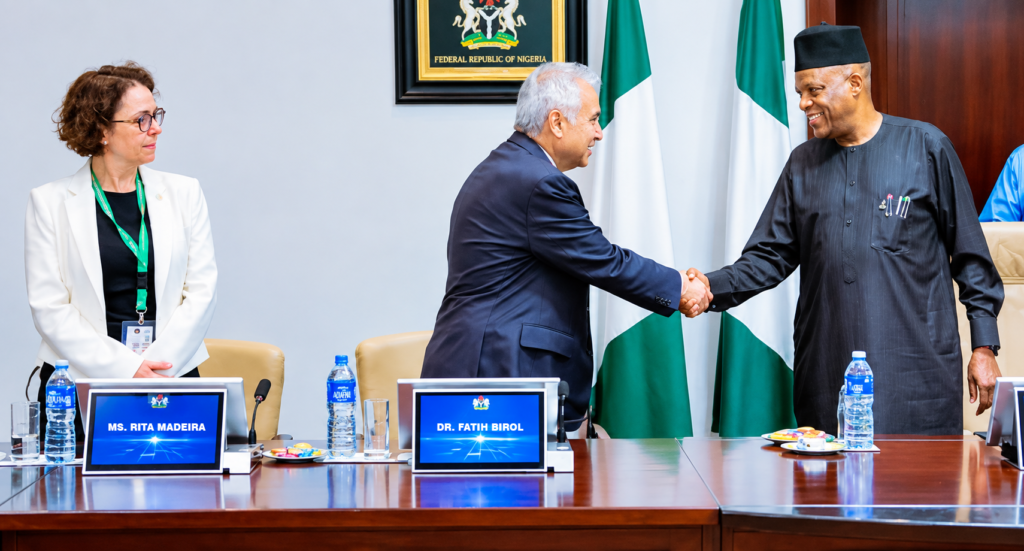
On September 3, 2026, Nigeria’s Vice President Kashim Shettima and International Energy Agency Executive Director Fatih Birol sat across from each other in the State House in Abuja and signed a Joint Work Programme, making Nigeria an IEA Association Country. Cameras clicked, statements were issued, and the Tinubu administration moved quickly to frame the moment as validation proof that its economic and energy reforms were winning international confidence.
But strip away the ceremony, and a harder question remains: what does this status actually deliver? Nigeria has long occupied an uncomfortable paradox: Africa’s largest energy producer, yet a country where power is unreliable, data is opaque, and investment has been chronically underwhelming relative to its resource base. IEA association won’t resolve that paradox on its own. What it offers is a toolkit: better data, easier access to capital markets, and technical know-how. What it cannot offer is the political will and domestic execution needed to use that toolkit well.
The Data Problem
Unreliable statistics carry a real financial cost. For years, foreign investors evaluating Nigerian energy projects have priced in a risk premium simply because they couldn’t trust the underlying numbers: production figures, loss rates, and emissions data. When the baseline is shaky, capital becomes more expensive by default.
The Joint Work Programme’s most concrete deliverable addresses exactly this. Working alongside Nigerian bodies such as the Energy Commission of Nigeria and the Nigerian Upstream Petroleum Regulatory Commission, the IEA will help build a standardised data framework covering petroleum, gas, grid electricity, and off-grid renewables. That includes sharper measurement of gas flaring and pipeline losses and a push toward policymaking grounded in verifiable analytics rather than estimates. In effect, Nigeria is importing a credibility layer, aligning its energy accounting with the standards international markets already trust.
Making Projects Bankable
Better data matters most because of what it can unlock: capital. Africa’s upstream oil and gas investment has been shrinking for a decade, falling from roughly $68 billion in 2016 to about $37 billion in 2025, and Nigeria has felt that contraction sharply, compounded by pipeline vandalism, regulatory unpredictability, and currency instability.

Association status gives Nigeria a seat inside the world’s most influential energy-finance network, and Birol himself suggested that with the right framework, the country could double energy-sector investment within five years. That optimism rests on two mechanisms: policy alignment, where IEA advisory support helps bring Nigerian regulation closer to the environmental, social, and governance expectations international financiers now demand; and de-risking, where transparent data on gas supply, demand, and grid reliability makes projects easier for institutional investors to underwrite. For a country trying to monetise roughly 200 trillion cubic feet of gas reserves while scaling up solar microgrids, that shift in perceived risk could matter a great deal if the underlying fundamentals hold up to scrutiny.
Building People, Not Just Pipelines
The third component of the agreement is technical assistance: training Nigerian energy professionals directly with IEA specialists in both Paris and Abuja. The stated priorities are telling: reforming domestic gas market architecture and expanding clean cooking solutions, a matter of public health as much as energy policy, given how many Nigerians still depend on biomass for cooking. Grid modernisation and renewable integration round out the agenda. None of this is glamorous, but embedded technical capacity – expertise that stays in the country rather than flying in for a project and leaving – is often the difference between a reform that sticks and one that doesn’t outlast the officials who signed it.
What the Agreement Doesn’t Touch
Here is where the celebratory framing runs into its limits. The IEA is an analytical and advisory institution. It is not a development bank, and it has no capacity to enforce anything on the ground. Independent energy economists have been blunt about this: the agency can build the best data model in the world, but it cannot repair a collapsing distribution grid, guard a pipeline against crude theft, or stabilise an exchange rate.
Three structural problems remain entirely Nigeria’s to solve. First, the national grid itself is fragile and prone to system-wide collapse; no amount of technical advice substitutes for the billions of dollars in physical transmission and distribution upgrades the system actually needs. Second, security: oil losses from pipeline vandalism and illegal bunkering are a domestic law-enforcement and community-relations problem, not something a multilateral policy framework can resolve. Third, macroeconomic volatility, currency swings and difficulties repatriating profits continue to make foreign investors cautious, and that is governed by fiscal and monetary policy far removed from any energy ministry’s mandate.
An Operational Catalyst, Not a Guarantee
The honest way to describe IEA association status is as leverage rather than a solution. It buys Nigeria three genuinely valuable things: credibility with global capital markets, a modern analytical backbone, and a pipeline of trained technical talent. Those are not trivial gains for a country whose energy sector has long been hampered by exactly these deficits.
But leverage only pays off if it’s used. Nigeria still has to fix its grid, secure its pipelines, and stabilise its macroeconomic environment, none of which the IEA has any power to do for it. The signing in Abuja was a genuine milestone, but it was also, in a sense, the easy part. The real test of September 3, 2026, will be measured not in photo-ops but in whether the country converts better data and easier access to capital into actual megawatts, actual investment, and actual reform over the next several years. Right now, that outcome remains entirely unwritten and entirely Nigeria’s to determine.
