

The Federal Government has revealed that the sustained economic growth will lead to the achievement of the dreamed $1billion economy by 2030.
According to the Minister of Finance and the Coordinating Minister of the Economy, Taiwo Oyedele, the country’s real Gross Domestic Product (GDP) grew by 4.43 per cent year-on-year in the second quarter of 2026, up from 4.23 per cent recorded in the corresponding quarter of 2025.
This also represents an improvement from the 3.89 per cent recorded in the first quarter of 2026.
Oyedele said the Q2 performance lifted Nigeria’s real GDP growth for the first half of 2026 to 4.16 per cent, compared with 3.68 per cent in the first half of 2025.
Also, in the July Consumer Price Index (CPI) of the National Bureau of Statistics (NBS), headline inflation declined to 15.43 per cent or 50 basis point (bpts).
However, the food segment rose sharply from 17.52 per cent to 20.31 per cent last month, the highest since August last year.
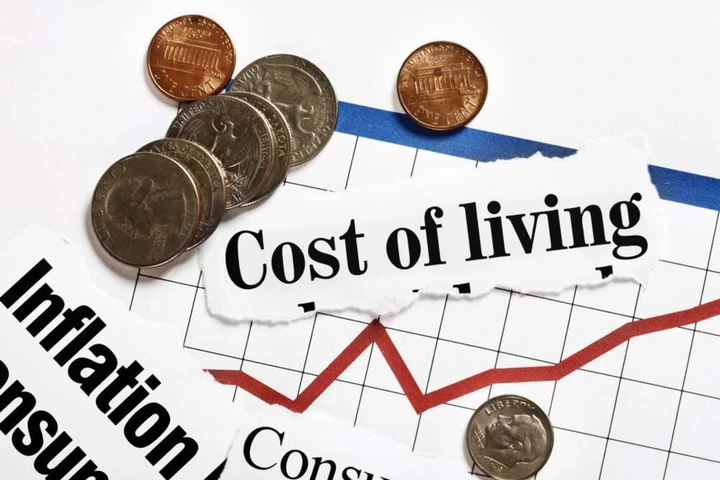
Despite the modest economic growth declining headline inflation, the high cost of living occasioned by rising food and energy prices should be addressed by the government.
For instance, a 50kg bag of rice costs between N80,000 and N90,000, while a medium-sized tuber of yam costs between N4,000 and N6,000. With the national minimum wage of N70,000 per month, not many Nigerians can afford their daily food needs.

As prices of food items and services are on the rise, the salaries of many Nigerians are stagnant.
The immediate cause of this economic reality can be traced to the removal of the fuel subsidy and the unification of the foreign exchange windows without putting adequate measures in place to ameliorate the consequences.
Floating the naira without robust domestic production infrastructure triggered a currency tailspin, turning every imported component – from industrial raw materials to basic pharmaceuticals – into a premium commodity.
Also, the high cost of transportation, driven by rising cost of petrol, has increased the cost of locally produced food.
Farmers cannot transport basic food items from agrarian hubs to urban centres without paying exorbitant transport fares, which are passed to the final consumers. Consequently, the gap between official statistics and human suffering has widened recently.
While policy papers celebrate dropping inflation, multi-dimensional poverty is affecting millions of citizens.
In its April 2026 Nigeria Development Update, the World Bank revealed that Nigeria’s poverty rate climbed to a staggering 63 per cent, meaning that roughly 140 million Nigerians now live below the poverty line, up from 56 per cent just two years prior.
The middle class is being pushed to the poverty line by static wages and soaring utility bills. Electricity tariffs have scaled upward, band-focused pricing has squeezed small businesses, and the cost of public transportation has risen astronomically.
With high cost of healthcare services, many citizens are forced to cut back on health, with some resorting to self-medication, while many patronise traditional healers and others consult faith clinics.
With increasing hunger, unemployment and poverty, the general insecurity has escalated. Kidnapping for ransom has become a thriving business across the country.
The food basket belt of the country has suffered so much on account of herdsmen killings and banditry. Due to violence in the agricultural zone, many farmers cannot safely access their farms. This has inexorable affected Nigeria’s food security.
No doubt, any country’s economic improvement is measured by purchasing power, employment metrics, and food security, not by favourable inflation statistics.
In other words, a nation’s economic growth should also be measured by improved living standard of the people and not necessarily by figures released by the World Bank, and the International Monetary Fund (IMF).
Therefore, the federal and state governments should come up with strategic measures to comprehensively address the rising cost of living in the country. The government said it saved trillions of naira from the removal of fuel subsidy.
This is the time the gains of fuel subsidy removal will be made to trickle down. Additionally, government should address the food shortage and high cost of transportation across the country.
Tackling the general insecurity affecting the rural communities will enable farmers to return to their farms and ensure regular food production cycles.
Similarly, targeted transport subsidies and food hubs will ensure a seamless movement of foods from the rural communities to urban markets.
Having a functional local government system will make rural areas more secure for rural inhabitants, as well as stimulate the local economy.
SOURCE: thesun.ng
