
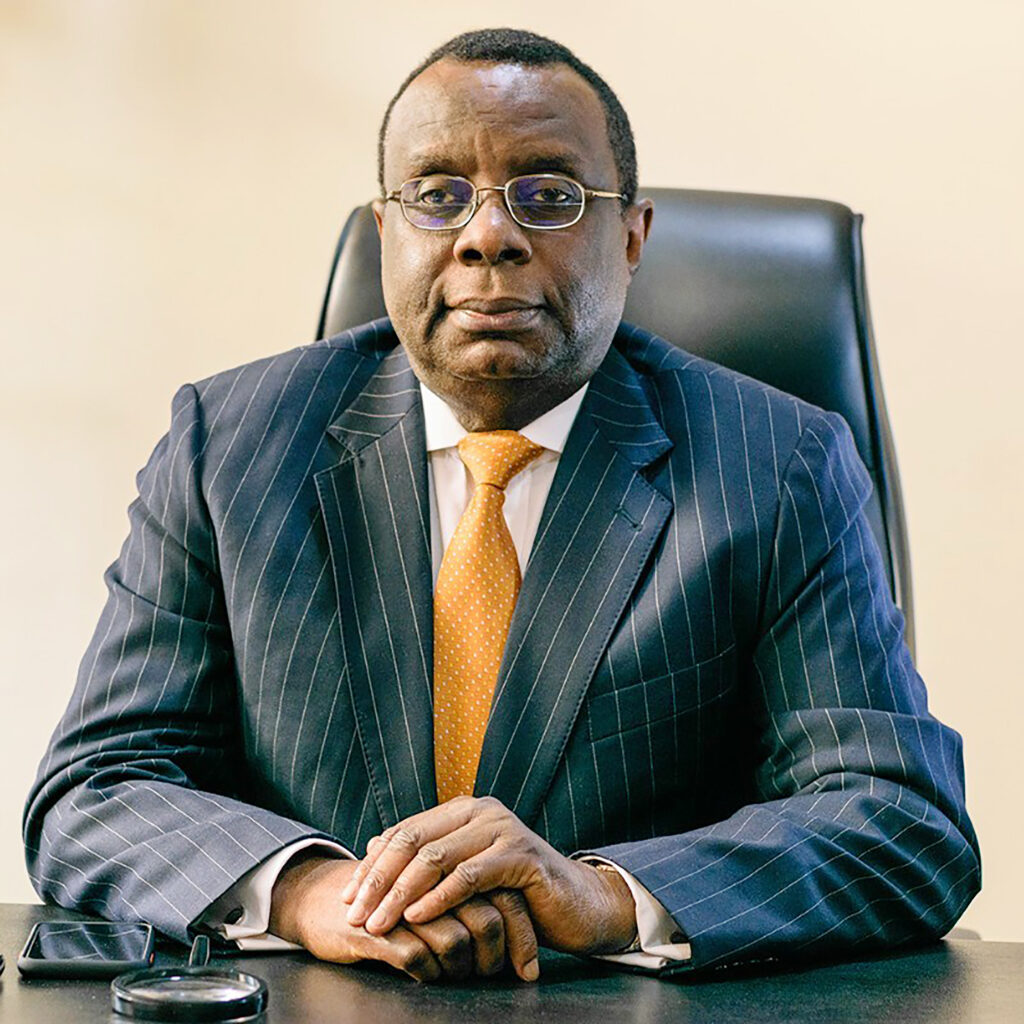
Dr. Timothy Effiong Okon is a distinguished geophysicist, petroleum economist, and strategist with over four decades of experience in the global oil and gas industry. Renowned for his deep institutional insight and expertise in petroleum economics, he is a member of several leading professional bodies, including the Society of Exploration Geophysicists (SEG), the International Association for Energy Economics (IAEE), the Association of International Petroleum Negotiators (AIPN), and the Nigerian Association of Petroleum Explorationists (NAPE).
Dr. Okon earned his BSc (Hons) in Geology/Geophysics from Ahmadu Bello University, Zaria, and went on to obtain advanced degrees—MSc, PhD, and DIC—from Imperial College London, alongside an MBA from Texas A&M University.
He began his career with ExxonMobil in 1978, holding senior positions across the United States, the United Kingdom, Indonesia, and Angola. In 2007, he joined the Nigerian National Petroleum Corporation (NNPC), where he led strategic reform efforts and made notable contributions to the Petroleum Industry Bill (PIB).
Between 2015 and 2019, Dr. Okon served as Special Technical Adviser (Fiscal) to the Minister of State for Petroleum Resources, helping to shape Nigeria’s fiscal framework for energy governance. He is currently the Managing Partner of Teno Energy Resources and Team Lead at MMELT Energies Limited, where he continues to influence strategic discourse on energy policy and economic transformation in Africa.
In this presentation, Dr. Timothy Effiong Okon shares his insights at the 18th Annual NAEE/IAEE International Conference about Nigeria’s evolving role in the global energy transition. Speaking with analytical depth and nationalistic conviction, he argues that import substitution, industrial mastery, and inclusive economic growth are the true pillars of Africa’s energy independence.
Dr. Timothy Effiong Okon’s vision reframes Africa’s energy debate from dependency to self-determination. His call for mastery, industrialisation, and import substitution underscores a truth often lost in policy rhetoric: sustainable energy transition begins with economic independence.
When we talk about global energy and Nigeria’s place in it, where do you think the real conversation should begin?
I think we must first confront two Nigerian realities. The global situation, as far as Nigeria goes, is now largely defined by our refining capacity. For years, we lamented about fuel imports and the consequences that came with them. That narrative is changing because Nigeria now has a refinery capable of meeting its domestic needs.
This shift represents what economists call import substitution, and I believe it holds the key to Africa’s economic development. Historically, the colonial model of dependency economics, where we exported raw materials and imported finished goods, has crippled countries like ours. Import substitution reverses that cycle. It builds sustainability and energy security from within.
Why is import substitution so critical to Africa’s energy future?
Because it anchors both energy sustainability and security. If Africa does not manufacture the inputs or components needed for its energy systems, whether fossil-based or renewable, we will continue to depend on others.
Take renewable energy: if we don’t make our own solar panels, batteries, or turbines, then the so-called transition simply swaps one form of dependency for another. When we talk about “transition”, it implies moving from one system to another, but have we mastered what we already have? Nigeria still faces energy insecurity; our power grid is fragile. So, any transition must begin with mastery, understanding and optimising existing systems before leaping forward.
Let’s talk about that mastery you mentioned. What does it mean in practical terms?
Mastery starts small. It’s better for Nigeria to develop and reliably generate 100 megawatts of power than to procure 1,000 megawatts that never work. Competence is built from small victories.
When we master small systems technically, institutionally, and operationally, we can scale with confidence. The lack of mastery is why we keep importing technologies we can’t maintain. It’s the same story across industries: we want big outcomes without first perfecting the fundamentals.
How do you see the Dangote Refinery changing Nigeria’s economic landscape?
The Dangote Refinery is a genuine market disruptor. It completely changes Nigeria’s energy equation.
For the first time, we are substituting imported fuels with fuels produced domestically. That means economic value retained at home—jobs, taxes, and industrial linkages. It will inevitably disrupt markets in places like Lomé that rely on imports.
It’s exactly what happened in the cement industry when Nigeria moved from being a major importer to a net exporter. That shift was built on import substitution, and it created jobs, stabilised prices, and encouraged local investment. The refinery can replicate that success for the energy sector.
You’ve often drawn parallels between the cement and energy sectors. Could you expand on that?
Yes. I remember when imported cement clogged our ports. Foreign-owned firms produced barely 1.2 million tonnes locally. Ownership kept shifting—from British to French, then Swiss, now Chinese—yet all major decisions were made abroad.
That’s the danger of dependency: your future is determined in someone else’s boardroom. Once Nigeria fostered local capacity through companies like Dangote Cement, we saw self-reliance translate into national growth.
The same principle must apply to energy. We must be the architects of our own industrial capacity, not passive consumers of foreign policy.
Looking globally, what can Nigeria learn from the U.S.–China economic rivalry?
The key lesson is that no nation prospers on dependency. The friction between the U.S. and China stems from China’s refusal to remain a low-cost producer forever. China invested in industrialisation, innovation, and technology mastery—designing its own chips, building its own infrastructure.
That strategic transformation disrupted global supply chains and shifted the balance of power. For Africa, the takeaway is simple: we must invest in self-sufficiency and technology capability. Only then can we survive, whatever direction the energy market takes.
What ultimately decides which energy systems survive the politics or the economics?
Always economics. The energy source that survives is the one that remains economically viable.
Africa contributes less than 3 per cent of global emissions. We’re not the ones causing climate change. Yet, those responsible for the bulk of emissions are the ones pushing restrictive policies on us. We must not allow external pressure to dictate our development pace.
Our energy choices must be guided by African economics, not foreign agendas. What benefits our economies should be our compass—not what appeases others.
How can we make sure this transition is also inclusive and people-centred?
Two things.
First, ensure that economic growth is inclusive—that energy development translates into jobs, skills, and social mobility. Import substitution does that naturally because it localises production.
Second, align industrial policy with energy policy. If we’re pursuing renewables, we should be building industries that fabricate panels, turbines, and storage systems right here. Otherwise, we will keep exporting opportunities and importing dependency.
Finally, what’s your key message to policymakers and energy leaders?
My message is: master the small things. Build competence from the ground up. Industrialisation doesn’t happen by importing big, ready-made solutions—it happens through consistent, incremental mastery.
If Nigeria and Africa can localise production, invest in technology, and prioritise import substitution, we will secure our energy future and redefine our place in the global economy.
Thank you.
