
By Adaobi Rhema Oguejiofor
In a world driven by innovation and technological advancements, size is no longer a limit to impact. Nanotechnology, which involves the science of understanding, manipulating and controlling matter at the atomic and molecular scale, is proof of that. This technology is fast transforming the boundaries of what is possible. From revolutionising medicine and electronics to creating sustainable materials and smarter energy solutions, nanotechnology is subtly reshaping industries and daily life.
This innovation requires the understanding and control of matter at the nanometre scale. This nanoscale deals with dimensions between approximately 1 and 100 nanometres. A nanometre (nm) is an extremely small unit of length, a billionth (10–9) of a meter.
On the nanometre scale, materials may exhibit unusual properties. For instance, when the size of a particle is changed, it can change colour. This occurs because, in nanometre-scale particles, the arrangement of atoms reflects light differently. Gold can appear to be dark red or purple, while silver can appear to be yellowish or amber-coloured.
History of Nanotechnology
Richard Feynman, a United States physicist, is regarded as the father of nanotechnology. He introduced the ideas and concepts behind nanotech during a talk in 1959 titled “There’s Plenty of Room at the Bottom”. Feynman did not use the term “nanotechnology” at the time, but he described a process in which scientists would be able to manipulate and control individual atoms and molecules.
Years later, in 1981, modern nanotechnology was born when the scanning tunnelling microscope allowed scientists and engineers to see and manipulate individual atoms. IBM scientists Gerd Binnig and Heinrich Rohrer won the 1986 Nobel Prize in Physics for inventing the scanning tunnelling microscope. The Binnig and Rohrer Nanotechnology Centre in Zurich, Switzerland, continues to build on the work of these pioneering scientists by conducting research and developing new nanotechnology applications.
By the end of the 20th century, many companies and governments were already investing in nanotechnology. Major nanotech discoveries, such as carbon nanotubes, were made throughout the 1990s. And by the early 2000s, nanomaterials were being used in consumer products from sports equipment to digital cameras.
Although modern nanotechnology may be relatively new, nanometre-scale materials have been used for centuries.
Nanotech and the Environment
Nanotechnology has a significant impact on the environment and everything around it. Many governments, scientists, and engineers are still researching the potential of nanotechnology in order to bring about affordable, high-tech, and energy-efficient products to millions of people around the world. Nanotechnology has improved the design of products such as light bulbs, paints, computer screens, and fuels.
- Energy
In the energy sector, nanotechnology is helping inform the development of alternative energy sources, such as solar and wind power. For instance, solar cells turn sunlight into electric currents. Nanotechnology could change the way solar cells are used, making them more efficient and affordable. These solar cells, also called photovoltaic cells, are usually assembled as a series of large, flat panels. These solar panels are big and bulky. They are also expensive and often difficult to install.
Using nanotechnology, scientists and engineers have been able to experiment with print-like development processes, which reduce manufacturing costs. Some experimental solar panels have been made in flexible rolls rather than rigid panels. - Water
In many parts of the world, especially third-world countries, access to clean water has become a problem, and nanomaterials may be a tiny solution to this large problem. This is because the technology is capable of stripping water of toxic metals and organic molecules. For example, researchers have discovered that nanometre-scale specks of rust are magnetic, which can help remove dangerous chemicals from water. Other engineers are developing nanostructured filters that can also eliminate viruses from water.
Researchers are also experimenting with a process called desalination using nanotechnology to safely, affordably, and efficiently turn saltwater into freshwater. In one experiment, nano-sized electrodes are being used to reduce the cost and energy requirements of removing salts from water.
Nanotech and People
Nanotechnology is helpful to people and their daily lives. Hundreds of consumer products are already benefiting from nanotechnology. From what people wear, down to what they eat or even breathe.

- Nanomedicine
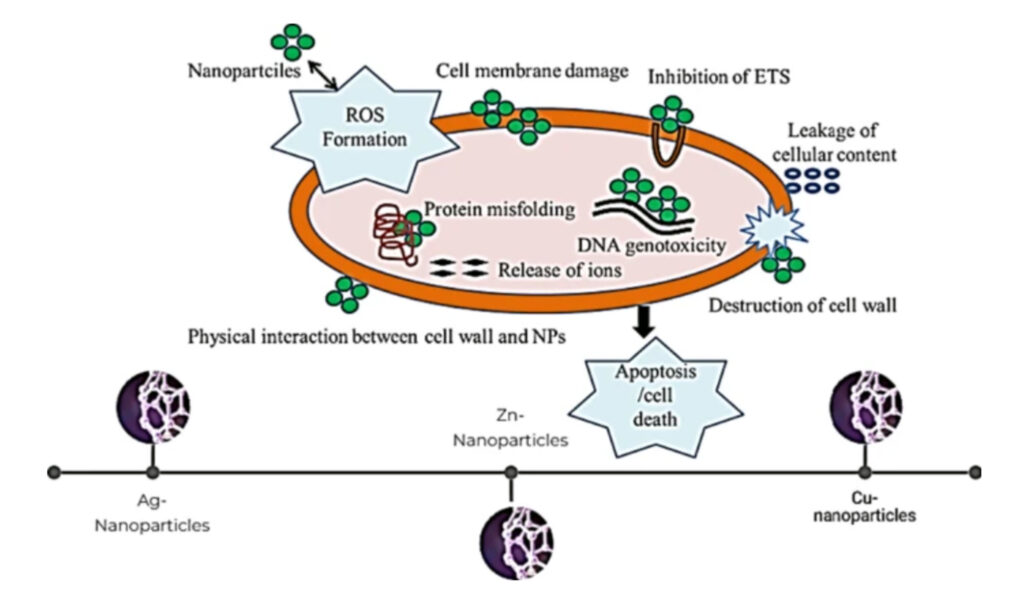
Nanotechnology can help medical tools and procedures be more personalised, portable, cheaper, safer, and easier to administer. For instance, silver nanoparticles, when incorporated into bandages, kill harmful microbes. This can be especially useful in healing burns. Nanotech is also furthering advances in disease treatments. Researchers are also developing ways to use nanoparticles to deliver medications directly to specific cells. This is particularly promising for the treatment of cancer, because chemotherapy and radiation treatments can damage healthy as well as diseased tissue. - Clothing
Scientists and engineers are using nanotechnology to enhance clothing. They do this by coating fabrics with a thin layer of zinc oxide nanoparticles. For instance, manufacturers can create clothes that give better protection from ultraviolet (UV) radiation, like those emitted by the sun. Some clothes have nanoparticles in the form of little hairs or whiskers that help repel water and other materials, making fabrics more stain-resistant. - Cosmetics
Many cosmetic products now contain nanoparticles. Nanometre-scale materials in these products provide greater clarity, coverage, cleansing, or absorption. For instance, the nanoparticles used in sunscreen (titanium dioxide and zinc oxide) provide reliable and extensive protection from harmful UV radiation. These nanomaterials offer better light reflection for a longer period. Nanotechnology may also provide better “delivery systems” for cosmetic ingredients. Nanomaterials may be able to penetrate a skin’s cell membranes to augment the cell’s features, such as elasticity or moisture.
Challenges and Concerns
The list of the benefits of nanotechnology goes on and on, but despite these, there are concerns and challenges surrounding the innovation.
One major concern is the issue of safety. Because nanoparticles can penetrate the skin and interact with cellular structures, some scientists worry that long-term exposure could have unknown effects on human health. For example, inhaling certain nanoparticles might lead to respiratory issues, or nanoparticles used in cosmetics could accumulate in the body over time and lead to uncertain consequences.
Environmentally, the risks are still being studied. While nanomaterials may make water clean or reduce emissions, they could also pose risks if they accumulate in soil or aquatic systems. The small size that gives nanomaterials their power can also make them difficult to contain or remove from ecosystems once released.
Another key issue is regulation and standardisation. Nanotechnology is developing so rapidly that policies and frameworks to monitor its use, production, and disposal are often delayed. Without proper regulations, the misuse or unintended consequences of nanotech could go unchecked.
Nanotechnology has a promise for shaping a better, smarter, and more sustainable world. From life-saving medical treatments to clean energy solutions and advanced consumer goods, the power of the tiny is proving to be transformational. However, like all powerful tools, it must be developed and used responsibly, with careful attention to safety, ethics, and equitable access.
