By Adaobi Rhema Oguejiofor
The call for global efforts to achieve the reduction and possible elimination of carbon emissions to combat climate change, thereby leading to the transition to a low-carbon or net-zero economy is on the increase. To this end, the Women in Energy, Oil and Gas (WEOG) forum, a Non-Governmental Organization, is advocating for an innovative and collaborative approach towards decarbonization for sustainable energy and zero emission.
To achieve this goal, the National President of WEOG, Dr. Oladunni Owo, during a briefing on the organization’s decarbonization programme in Abuja, said that September 3rd – 5th has been set aside for WEOG’s World Decarbonization Summit.
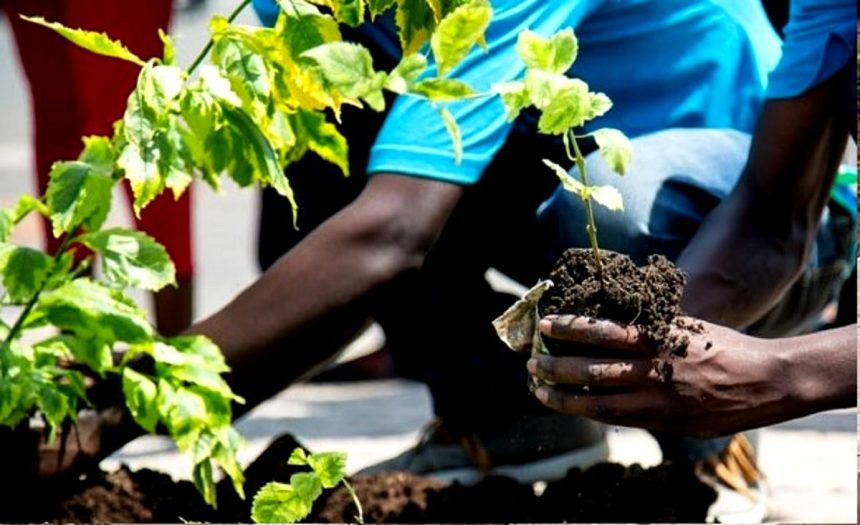
According to Owo, based on the organization’s World Decarbonization Initiative, the main target is to plant about 10 million trees with a minimum of 20,000 trees planted in each of the 774 Local Government Areas (LGAs) of the nation, including the Federal Capital Territory (FCT).
She noted that the organization decided to take a position to go into deep research and align with future energy renewables and climate action committees.
In her words, “After the research, we wanted a pragmatic programme, so we inaugurated a project and also researched on different trees for decarbonizing the environment for the ecosystem.
“By the virtue of industrialization, we have more carbon in the atmosphere causing depletion of the ozone layers, global warming, carbon pollution and emission, among others. Carbon can be captured, converted, and stored in the oil well to mitigate emission.’’
Owo expressed that with decarbonization, oil and gas resources could still be very useful because research discovered that apart from Premium Motor Spirit (PMS), commonly referred to as fuel in Nigeria, there are other energy value chains such as fertilizer, polyester, petrochemicals and several other products.
“How can we make the exploration and production of oil and gas clean in such a way that it will not affect the ecosystem? The simplest way for decarbonizing is tree planting.
“In Africa, there is a huge energy gap, whether it is solar, wind, hydrogen and nuclear; we need every energy resource, including oil and gas, to close the gap,’’ she said.
Among the reasons behind the idea of planting of about 10 million trees is to reduce the amount of Carbon Dioxide (CO2) and emissions in the atmosphere, helping to lessen climate change because trees have the capacity to absorb CO2 from the atmosphere through photosynthesis, storing it in their trunks, branches, and roots. Also, trees produce oxygen (O2) as a byproduct of photosynthesis, which is released into the atmosphere, increasing the oxygen levels available in the atmosphere. However, the planting of trees is just one aspect of decarbonization efforts.
On her part, the Chairperson, Future Energy and Renewable Committee, WEOG, Mrs. Toyin Yusuf, listed major projects under the decarbonization initiative to include the 10 million Tree Decarbonization Project, Renewable Energy Transition Project, and Clean Cooking Project, the Electric Vehicle Project, Monthly Decarbonization Webinars, Declaration and Promotion of World Decarbonization Day, Annual World Decarbonization Summit and Collaboration and Partnership Opportunities.
She also extended an invitation to stakeholders, industry experts, and potential partners to join and support the initiative.
Meanwhile, the Women in Energy Network (WIEN), another leading gender equity advocate in the energy sector, expressed immense joy at the eventual approval of oil and gas asset divestment transactions by the government.
The President of WIEN, Mrs. Eyono Fatai-Williams, while speaking in Lagos, declared that the decision of the Tinubu-led administration to work with all parties in the transactions to close the deals indicates the exciting resolve of his government to pave the way for progress in the industry, which has suffered so much stagnation in the past decades.
She noted that the eventual approval of the divestment deals would open up greater growth opportunities for the domestic economy, enhance oilfield activities, contribute to production recovery, boost foreign exchange income and also absorb more local content.
Earlier, the Commission Chief Executive (CCE) of the Nigeria Upstream Petroleum Regulatory Commission (NUPRC), Mr. Gbenga Komolafe, during his presentation at the 2024 Nigerian Oil and Gas (NOG) Energy Week in Abuja, announced that the first set of approvals has been given to parties who have completed processes for ministerial approval.
According to him, the indigenous energy company, Oando Energy Resources (OER), would now proceed to acquire the 20 percent stake being divested by the Nigeria Agip Oil Company (NAOC) in oil blocks operated under NNPC/NAOC/Oando Joint Venture (JV) located onshore Niger Delta.
Komolafe declared that “The NAOC-Oando divestment has been concluded. The signing ceremony is to be conducted in the coming days. The Equinor-Project Odinmim divestment has also been completed. Also, the signing ceremony is to be conducted in the coming days. For the SPDC–Renaissance deal, documents have been submitted by SPDC. The documents are undergoing due diligence as we speak.”
He added that the NUPRC was still awaiting an application for ministerial consent from the parties in the ExxonMobil– Seplat deal.
Fatai-Williams, while describing the success of the divestments as a demonstration of local operating and financial capacity, expressed delight that the time, funds and hopes staked in the transactions have been justified. She, however, called on the government’s lease administrator and parties in the remaining divestment deals to quickly drive the transactions to completion.
According to her, the time for Nigeria to seize control of the industry and also reap the full benefits of its resources has come. She further pointed at the rising professionalism, expertise and operating capacity of Nigerians in the industry as key indices of the results the Nigerian Content policy has delivered in the past 12 years of active implementation.
The WIEN president also charged the new players in the divested interests to feel challenged by the need for rapid recovery of oilfield activities in the acquired assets and drive aggressive exploration and production to assist in building reserves and output.
Fatai-Williams, while pointing out that the divested assets have suffered stagnation in new investments and work programmes, urged Nigerian companies to step into the shoes of the exiting International Oil Companies (IOCs) with confidence and add value to the acquired assets. She noted that, it took Nigerian players in the industry to re-enter and reactivate marginal fields earlier sidelined by the international oil companies for their low potential for commercial returns on development investments. She added that Nigerian companies like Seplat, Xenergi, Platform and Nedogas are now leading lights in upstream gas harnessing, processing and commercialization.
“With Nigerians in charge, there would be a guarantee of full domiciliation of industry job execution, patronage to the domestic economy, local industrial stimulus and value chain optimization in the industry,” she explained.
The president urged all Nigerian JV partners in the various assets to avoid the pitfall of disputes and the trap of scramble for operatorship, adding that a performing venture delivers good value for all stakeholders.
